
Article Outline
- Demystifying the 500D Specification in Polyester Filament
- The Foundation of Yarn Measurement
- Technical Specifications of 500D Polyester Filament
- Manufacturing Process: Creating 500D Polyester Filament
- Physical and Mechanical Properties: Performance Analysis
- Comparative Analysis: 500D vs. Other Common Deniers
- Primary Applications Across Industries
- Economic Considerations: Cost Structure and Market Value
- Quality Standards and Testing Protocols
- Supply Chain and Sourcing Strategies
- Processing and Manufacturing Guidelines
- Sustainability and Environmental Impact
- Innovations and Future Developments
- Procurement Best Practices for Industrial Buyers
- Strategic Implementation of 500D Polyester Filament
Comprehensive Guide to 500D Polyester Filament: Understanding Specifications, Applications, and Industry Impact
1. Demystifying the 500D Specification in Polyester Filament
In the complex ecosystem of synthetic textile manufacturing, denier specifications serve as critical markers of yarn characteristics and application suitability. The designation “500D” represents a specific category of polyester filament that occupies a strategic position in the industrial textile hierarchy. For procurement managers, production engineers, and product developers across apparel manufacturing, technical textiles, home furnishings, and industrial applications, understanding 500D polyester filament is essential for making informed material selections and optimizing production processes. This comprehensive guide explores 500D polyester filament from fundamental definitions to advanced applications, providing industry professionals with the technical knowledge and strategic insights needed to leverage this versatile material effectively. By mastering the nuances of 500D specifications, textile professionals can enhance product quality, control costs, and create competitive advantages in diverse market segments.
2. The Foundation of Yarn Measurement
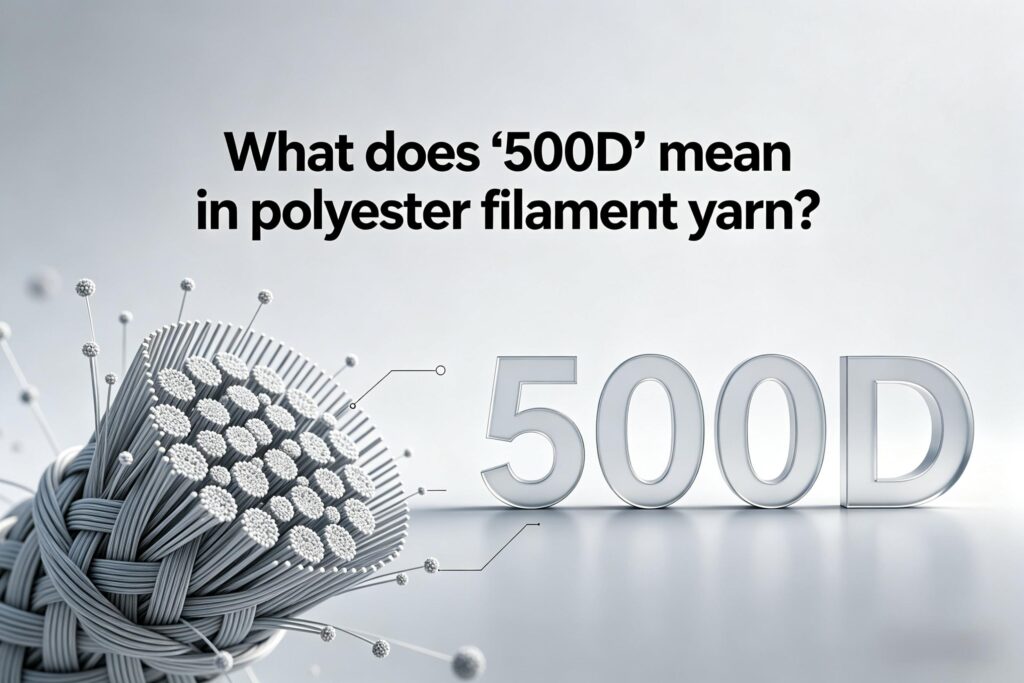
Denier (abbreviated as “D”) represents a fundamental unit of linear density measurement in the textile industry, particularly for continuous filament yarns. This measurement system originated in the silk industry and has become standardized globally for synthetic fibers.
Definition and Calculation:
- Standard Definition: Denier measures the mass in grams of 9,000 meters of yarn
- Formula: Denier = (Weight in grams) / (Length in meters / 9,000)
- Practical Example: A 500D yarn weighs 500 grams per 9,000 meters of length
Historical Context and Industry Adoption:
- Origin: Derived from the French “denier,” a historical coin and weight measurement
- Evolution: Adapted from silk to synthetic fiber measurement in the 20th century
- Global Standardization: Recognized by ASTM, ISO, and other international bodies
Alternative Measurement Systems:
- Decitex (dtex): Metric equivalent: 1 denier = 0.9 decitex (500D = 450 dtex)
- English Cotton Count (Ne): Indirect system primarily for spun yarns
- Metric Count (Nm): Length per unit weight measurement
Industry Significance of Denier System:
- Direct correlation: Higher denier = thicker/heavier yarn
- Production planning: Enables precise material requirement calculations
- Cost estimation: Facilitates accurate pricing and budgeting
- Performance prediction: Correlates with strength, durability, and coverage
3. Technical Specifications of 500D Polyester Filament
500D polyester filament exhibits specific technical characteristics that define its performance capabilities and application potential.
Core Specifications Table:
| Parameter | Standard Range | Typical Value | Measurement Method |
|---|---|---|---|
| Denier | 495-505D | 500D | ASTM D1907 |
| Filament Count | 72F, 96F, 144F | 96F | Microscopic Count |
| Denier per Filament | 5.2-7.0 | 5.2 (96F) | Calculated |
| Tenacity | 7.0-8.5 g/d | 7.8 g/d | ASTM D2256 |
| Elongation at Break | 15-25% | 20% | ASTM D2256 |
| Modulus | 80-100 g/d | 90 g/d | ASTM D2101 |
| Shrinkage (boiling water) | 3-6% | 4.5% | AATCC 135 |
| Moisture Regain | 0.3-0.5% | 0.4% | ASTM D2495 |
Additional Technical Parameters:
- Cross-section: Primarily circular, with specialized profiles available
- Luster: Bright, semi-dull, or full-dull depending on TiO₂ content
- Spin finish: Typically 0.4-0.8% applied for processing
- Intermingling: 40-80 nodes per meter for cohesion
- Thermal properties: Melting point 255-265°C
Quality Grades and Variations:
- Premium grade: ±1% denier tolerance, excellent uniformity
- Standard grade: ±2% denier tolerance, good processing characteristics
- Economy grade: ±3% denier tolerance, suitable for non-critical applications
4. Manufacturing Process: Creating 500D Polyester Filament
The production of 500D polyester filament involves sophisticated manufacturing technologies and precise process control.
Production Sequence Overview:
- Polymer Preparation: PTA and MEG polymerization to achieve IV of 0.65-0.70 dL/g
- Melt Spinning: Extrusion through spinnerets at 285-295°C
- Quenching: Solidification with controlled air flow at 18-22°C
- Drawing: Orientation through multiple godet stages at 3.5:1 to 4.0:1 ratio
- Heat Setting: Thermal stabilization at 180-220°C
- Intermingling: Air entanglement for filament cohesion
- Winding: Precision winding onto 3-5 kg packages
Critical Manufacturing Parameters:
| Process Stage | Key Parameters | Control Range | Impact on Properties |
|---|---|---|---|
| Spinning | Temperature, throughput | 290°C ± 2°C | Denier consistency |
| Drawing | Draw ratio, temperature | 3.8:1 ± 0.1 | Tenacity, elongation |
| Heat Setting | Temperature, tension | 200°C ± 5°C | Shrinkage control |
| Winding | Speed, tension | 3200 m/min ± 50 | Package quality |
Advanced Manufacturing Technologies:
- Direct spinning: Integrated polymerization and spinning for consistency
- High-speed winding: Up to 4000 m/min for increased productivity
- Automated quality control: Real-time monitoring and adjustment
- Energy recovery systems: Heat capture and reuse
5. Physical and Mechanical Properties: Performance Analysis
500D polyester filament exhibits a distinctive property profile that determines its application suitability.
Mechanical Performance Data:
| Property | Measurement | 500D Value | Industry Comparison |
|---|---|---|---|
| Tensile Strength | Breaking force (N) | 350-400 | 60% higher than 300D |
| Tear Resistance | Elmendorf (N) | 45-55 | Excellent for heavy-duty use |
| Abrasion Resistance | Martindale (cycles) | 35,000-45,000 | Superior durability |
| Flex Endurance | Bending cycles | 25,000-35,000 | Good flexibility for weight |
| Impact Resistance | Energy absorption (J) | 8-12 | High for protective applications |
Physical Characteristics:
- Diameter: Approximately 0.25-0.30 mm for 96F configuration
- Density: 1.38 g/cm³ (standard PET)
- Specific gravity: 1.38
- Refractive index: 1.58-1.62
- Thermal conductivity: 0.14 W/m·K
Functional Performance Metrics:
- Cover factor: High due to substantial yarn diameter
- Opacity: Excellent light blockage
- Wind resistance: Superior barrier properties
- Chemical resistance: Excellent against most common chemicals
- UV resistance: Good natural resistance, enhanced with additives
6. Comparative Analysis: 500D vs. Other Common Deniers
Understanding 500D’s position within the denier spectrum is crucial for appropriate material selection.
Denier Comparison Matrix:
| Denier | Filament Count | Typical DPF | Primary Applications | Relative Cost |
|---|---|---|---|---|
| 300D | 72F, 96F | 3.1-4.2 | Medium-weight fabrics | 0.75x |
| 500D | 96F, 144F | 3.5-5.2 | Heavy-duty fabrics | 1.00x |
| 1000D | 192F, 288F | 3.5-5.2 | Extreme-duty applications | 1.35x |
| 1500D | 288F, 384F | 3.9-5.2 | Industrial reinforcements | 1.70x |
Performance Comparison Table:
| Performance Aspect | 300D | 500D | 1000D |
|---|---|---|---|
| Weight (gsm in plain weave) | 180-220 | 280-340 | 450-550 |
| Tensile Strength | Good | Very Good | Excellent |
| Flexibility | Very Good | Good | Moderate |
| Abrasion Resistance | Good | Very Good | Excellent |
| Cost Efficiency | High | Optimal | Lower |
Application-Based Selection Guidelines:
- Below 300D: Lightweight applications, apparel, linings
- 300-500D: Balanced performance for diverse applications
- 500-1000D: Heavy-duty requirements, technical applications
- Above 1000D: Specialized industrial and extreme conditions
7. Primary Applications Across Industries
500D polyester filament serves critical functions across multiple industry sectors due to its balanced performance characteristics.
Apparel and Footwear:
- Protective clothing: Workwear, safety garments, military apparel
- Outdoor gear: Backpacks, luggage, hiking equipment
- Footwear components: Reinforcements, trim, decorative elements
- Sporting goods: Equipment bags, protective padding
Technical and Industrial Textiles:
- Industrial fabrics: Conveyor belts, filtration media, reinforcement fabrics
- Transportation: Automotive interiors, truck covers, marine applications
- Geotextiles: Erosion control, stabilization, drainage layers
- Agricultural textiles: Crop covers, shade fabrics, protective netting
Home and Commercial Furnishings:
- Heavy-duty upholstery: Furniture, commercial seating, public transport
- Window treatments: Blackout curtains, commercial blinds
- Floor coverings: Carpet backing, matting, protective floor covers
- Decorative applications: Wall coverings, room dividers
Application-Specific Requirements:
| Application | Preferred Configuration | Key Property Requirements |
|---|---|---|
| Backpacks | 500D/96F nylon-coated | Abrasion resistance, tear strength |
| Workwear | 500D/144F FR-treated | Flame resistance, durability |
| Industrial Belting | 500D/72F high-tenacity | Tensile strength, dimensional stability |
| Automotive Upholstery | 500D/96F solution-dyed | Color fastness, cleanability |
8. Economic Considerations: Cost Structure and Market Value
Understanding the economic dynamics of 500D polyester production and application is essential for value optimization.
Production Cost Analysis:
| Cost Component | Percentage | Key Factors |
|---|---|---|
| Raw Materials (PET) | 65-75% | PTA/MEG prices, polymer quality |
| Energy | 15-20% | Electricity, thermal energy |
| Labor and Maintenance | 8-12% | Automation level, wage rates |
| Spin Finish and Additives | 2-4% | Chemical costs, application efficiency |
| Quality Control | 1-3% | Testing, inspection, waste |
Market Pricing Structure (2024):
- Standard 500D filament: $2.80-3.50/kg
- Premium technical grades: $3.50-4.50/kg
- Specialty variants: $4.00-6.00/kg
- Custom developments: $5.00-8.00/kg
Value Chain Economics:
- Raw material to yarn: 15-25% value addition
- Yarn to fabric: 30-50% value addition
- Fabric to finished product: 50-150% value addition
- Total value multiplication: 3-6x from polymer to retail
9. Quality Standards and Testing Protocols
Maintaining consistent quality in 500D polyester production requires adherence to established standards and comprehensive testing.
International Standards Compliance:
- ASTM D1907: Standard Test Method for Yarn Number
- ISO 2060: Determination of Linear Density
- ASTM D2256: Tensile Properties of Yarns
- AATCC Test Methods: Performance characteristics
Quality Testing Framework:
| Test Parameter | Method | Frequency | Acceptance Criteria |
|---|---|---|---|
| Denier Verification | Cut and weigh | Each lot | 495-505D |
| Tenacity | Grab test | Every 4 hours | ≥7.0 g/d |
| Elongation | Extension measurement | Every 8 hours | 15-25% |
| Evenness | Uster testing | Continuous | U% < 1.2% |
| Shrinkage | Boiling water test | Each lot | 3-6% |
| Intermingling | Node count | Each shift | 40-80/meter |
Certification Requirements:
- Material composition: 100% polyester verification
- Performance certification: Meeting claimed specifications
- Safety compliance: Free from restricted substances
- Sustainability claims: Verified recycled content if applicable
10. Supply Chain and Sourcing Strategies
Effective sourcing of 500D polyester filament requires understanding of global supply dynamics and strategic relationship management.
Global Production Distribution:
- China: 65-70% of global capacity
- India: 15-20% with growing capability
- Southeast Asia: 8-12% expanding rapidly
- Other regions: 3-5% specialized production
Supplier Classification:
- Integrated producers: Full control from polymer to filament
- Specialized manufacturers: Focus on specific filament types
- Trading intermediaries: Sourcing and logistics services
- Brand-aligned suppliers: Dedicated to specific requirements
Sourcing Strategy Components:
- Supplier qualification: Technical capability, financial stability, compliance record
- Risk management: Diversified sourcing, inventory strategies, contingency planning
- Relationship management: Long-term partnerships versus transactional approaches
- Total cost optimization: Beyond purchase price to total cost of ownership
11. Processing and Manufacturing Guidelines
500D polyester filament exhibits specific processing characteristics that affect manufacturing efficiency and product quality.
Weaving and Knitting Considerations:
- Loom requirements: Heavy-duty looms with appropriate tension control
- Weaving speed: Typically 20-30% slower than lighter deniers
- Needle selection: Appropriate gauge for filament thickness
- Tension control: Critical to prevent distortion and ensure uniformity
Finishing Operations:
- Heat setting: Essential for dimensional stability
- Coating applications: Good substrate for various coatings
- Dyeing considerations: May require specialized equipment for even penetration
- Calendering: Surface treatment for desired aesthetics
Quality Control in Processing:
- Tension monitoring: Continuous measurement and adjustment
- Temperature control: Critical for thermal processes
- Chemical compatibility: Verification with processing chemicals
- Equipment maintenance: Regular calibration for consistent results
12. Sustainability and Environmental Impact
Environmental considerations increasingly influence material selection and processing decisions for 500D polyester filament.
Life Cycle Assessment Factors:
- Raw material production: Petrochemical based with recycled options
- Manufacturing energy: 5-7 kWh per kilogram of filament
- Water usage: Minimal in filament production, significant in dyeing/finishing
- Chemical management: Responsible chemical usage and wastewater treatment
- End-of-life options: Recyclable through multiple pathways
Sustainable Initiatives:
- Recycled content: rPET options with 30-100% recycled content
- Energy efficiency: Modern manufacturing with reduced energy consumption
- Chemical management: Implementation of ZDHC MRSL compliance
- Circular economy: Design for recyclability and closed-loop systems
Certification and Compliance:
- Global Recycled Standard (GRS): For recycled content verification
- OEKO-TEX® certifications: Various levels for different applications
- Bluesign®: Chemical management and environmental performance
- Carbon footprint reporting: Increasingly required by major brands
13. Innovations and Future Developments
The 500D polyester filament sector continues to evolve through technological innovation and market adaptation.
Recent Technological Advances:
- High-tenacity variants: Enhanced strength for specialized applications
- Multi-functional finishes: Built-in properties like antimicrobial, UV protection
- Smart manufacturing: Industry 4.0 implementation throughout production
- Sustainable technologies: Reduced environmental impact processes
Emerging Applications:
- Advanced composites: Reinforcement in new material systems
- Smart textiles: Integration of electronic functionality
- Medical innovations: Enhanced protective properties
- Architectural uses: Temporary and permanent structural applications
Research and Development Focus:
- Performance enhancement: Higher functionality without weight increase
- Sustainability: Improved recyclability and reduced environmental impact
- Cost optimization: Maintaining quality while reducing production costs
- Customization: Flexible manufacturing for specific applications
14. Procurement Best Practices for Industrial Buyers
Effective procurement of 500D polyester filament requires strategic approaches and careful specification management.
Specification Development Process:
- Requirements analysis: Application needs, performance criteria, quality standards
- Technical specifications: Denier, filament count, strength, finishing requirements
- Quality parameters: Testing methods, acceptance criteria, certification needs
- Commercial terms: Pricing mechanisms, delivery schedules, contractual arrangements
Supplier Evaluation Framework:
- Technical capability: Production technology, quality control systems
- Financial stability: Long-term viability and risk assessment
- Compliance record: Regulatory, safety, and environmental compliance
- Innovation potential: R&D capability and technology adoption
- Customer service: Responsiveness and problem-solving capability
Risk Management Strategies:
- Supply diversification: Multiple qualified suppliers
- Inventory planning: Strategic safety stock management
- Quality assurance: Independent testing and verification
- Relationship development: Long-term partnerships with key suppliers
15. Strategic Implementation of 500D Polyester Filament
500D polyester filament represents more than just a textile material—it embodies a strategically important resource that balances performance, durability, and cost-effectiveness for demanding applications. For industry professionals across the textile value chain, mastery of 500D specifications, applications, and procurement strategies provides substantial competitive advantages in product development, cost management, and market responsiveness. As technological innovations continue to enhance material capabilities and sustainability considerations become increasingly important, understanding and effectively implementing 500D polyester filament becomes essential for optimizing product performance, managing costs, and meeting evolving market demands. By applying the comprehensive insights presented in this guide—from fundamental specifications to strategic implementation approaches—textile professionals can enhance their material expertise, strengthen their supply chain relationships, and create superior products in the dynamic global textile marketplace.
Frequently Asked Questions (FAQ)
Q1: What is the typical weight of fabric made from 500D polyester?
A: Fabric weight varies based on construction, but plain weave 500D polyester typically ranges from 280-340 gsm (grams per square meter). With coatings or laminations, this can increase to 400-500 gsm. The exact weight depends on weave density, finishing treatments, and any additional layers.
Q2: How does 500D compare to 1000D polyester in terms of strength?
A: While 1000D is approximately twice as strong in absolute terms (700-800N vs 350-400N breaking force), 500D offers better strength-to-weight ratio and greater flexibility. For many applications, 500D provides sufficient strength with better drape and lower cost.
Q3: Can 500D polyester be used for waterproof applications?
A: 500D polyester fabric is not inherently waterproof but provides excellent water resistance due to its tight weave. For waterproof applications, it requires additional treatments such as polyurethane coatings, laminated membranes, or specialized waterproof finishes.
Q4: What is the typical minimum order quantity for 500D polyester filament?
A: MOQs vary by supplier and product type. For standard 500D filament, typical MOQs range from 3-5 tons. Custom colors or specialty variants may require 5-10 tons. Some suppliers offer smaller quantities through stock programs at higher prices.
Q5: How does 500D nylon compare to 500D polyester?
A: 500D nylon typically offers better abrasion resistance and elasticity but lower UV resistance and higher cost. Polyester provides better chemical resistance, lower moisture absorption, and generally better color retention. The choice depends on specific application requirements.
Q6: What industries are the largest consumers of 500D polyester?
A: The main consumers include: protective workwear (25-30%), luggage and bags (20-25%), automotive interiors (15-20%), industrial fabrics (15-20%), and outdoor equipment (10-15%). The balance serves various technical and specialty applications.
Q7: How should 500D polyester fabrics be cleaned and maintained?
A: Most 500D polyester fabrics are machine washable in warm water (40°C maximum) with mild detergents. Avoid bleach and fabric softeners. Tumble dry on low heat or air dry. Ironing is rarely needed but can be done on low heat if necessary. Always check manufacturer care instructions.
Q8: What is the difference between 500D and 600D polyester?
A: 600D is approximately 20% heavier and thicker than 500D, offering slightly better strength and durability at the cost of increased weight and reduced flexibility. 500D provides a better balance for applications where weight and flexibility are important considerations.
Q9: Can 500D polyester be recycled?
A: Yes, 500D polyester is fully recyclable through both mechanical and chemical processes. Mechanical recycling involves shredding and remelting, while chemical recycling breaks the polymer down to its monomers. Many manufacturers now offer 500D products with recycled content.
Q10: What certifications should I look for when sourcing 500D polyester?
A: Key certifications include: OEKO-TEX Standard 100 (harmful substances), Global Recycled Standard (recycled content), Bluesign (chemical management), and ISO 9001 (quality management). Industry-specific certifications may also apply for applications like automotive or medical textiles.
Q11: How does filament count affect 500D yarn properties?
A: Higher filament counts (e.g., 144F vs 96F) create finer individual filaments (lower dpf), resulting in softer hand feel, better drape, and increased surface area. Lower filament counts create coarser filaments with higher stiffness and potentially better abrasion resistance.
Q12: What is the typical lead time for 500D polyester orders?
A: For standard products from stock, lead times are typically 2-4 weeks. Custom products or large orders require 6-10 weeks for production plus shipping time. Asian suppliers typically require longer shipping times but offer cost advantages, while regional suppliers provide faster delivery at potentially higher costs.
