
Table of Contents
- First, Let Me Be Honest – I Used to Ignore Yarn Categories Too
- What the Hell Is a Category 4 Yarn? (The Simple Definition)
- The Technical Specs – Not Just “Medium Weight”
- Category 4 vs. Category 3, 5, and 6
- Table 1: Side-by-Side Specs (Needle size, gauge, common uses)
- Table 2: Real-project performance (drape, warmth, stitch definition)
- Why Category 4 Became the Go-To for Most Makers (Hard Data Inside)
- Personal Experience: What I’ve Made with Cat 4 – The Wins and the Fails
- How to Spot a Mislabeled Category 4 Yarn (Yes, It Happens)
- Choosing Between Brands – My Unfiltered Comparison Table
- Table 3: Lion Brand, Red Heart, Cascade, Malabrigo, Joann’s Big Twist
- Best Projects for Category 4 – And What to Absolutely Avoid
- Frequently Asked Questions (FAQ)
1. First, Let Me Be Honest – I Used to Ignore Yarn Categories Too
A few years ago, I walked into a craft store, grabbed a ball of yarn that felt right, and wondered why my sweater turned out stiff as cardboard. Turned out, I’d picked a Category 5 bulky yarn and used needles meant for sock yarn. Frustrating? Absolutely.
That’s when I finally paid attention to those little yarn symbols on the label. And honestly? Category 4 – often called “worsted” or “aran” – saved my hobby. Not because it’s fancy, but because it’s the Goldilocks of yarn weights. Not too thin, not too thick. Just right for a massive range of projects.
2. What the Hell Is a Category 4 Yarn? (The Simple Definition)
Category 4 yarn is a medium-weight yarn as defined by the Craft Yarn Council’s standard weight system (CYC). It’s the most commonly used yarn weight in North America and much of Europe. You’ll often see it labeled as:
- Worsted (most common)
- Aran (slightly thicker within Cat 4)
- Afghan yarn
- Medium weight
In practical terms: think of a standard red acrylic yarn you’d find in a beginner’s kit. That’s Category 4. It’s thick enough to work up quickly but thin enough to show stitch details like cables, texture, or colorwork.
The official symbol looks like a yarn skein with a “4” inside. Yes, that tiny number you’ve ignored – it changes everything.
Quick numbers (official CYC standards):
- Knitting gauge: 16–20 stitches per 4 inches (10 cm)
- Crochet gauge: 11–14 single crochets per 4 inches
- Recommended needle size: US 7–9 (4.5–5.5 mm)
- Recommended hook size: US I-9 to K-10.5 (5.5–6.5 mm)
But numbers alone don’t tell the story. Let’s break it down further.
3. The Technical Specs – Not Just “Medium Weight”
Here’s where most online guides get lazy. They say “worsted weight” and stop. But Category 4 actually has a range of thicknesses, wraps per inch (WPI), and yardage per gram. Knowing this saves you from pattern disasters.
Wraps Per Inch (WPI): 9–12 WPI
That means if you wrap the yarn loosely around a ruler, you’ll get 9 to 12 wraps in one inch. Aran weight is on the higher end (10–12), standard worsted is around 9–10.
Yardage per 100g skein: Typically 190–240 yards (approx. 170–220 meters)
- Acrylic: often 220–240 yards
- Wool: 190–220 yards (heavier)
- Cotton: 180–210 yards (denser)
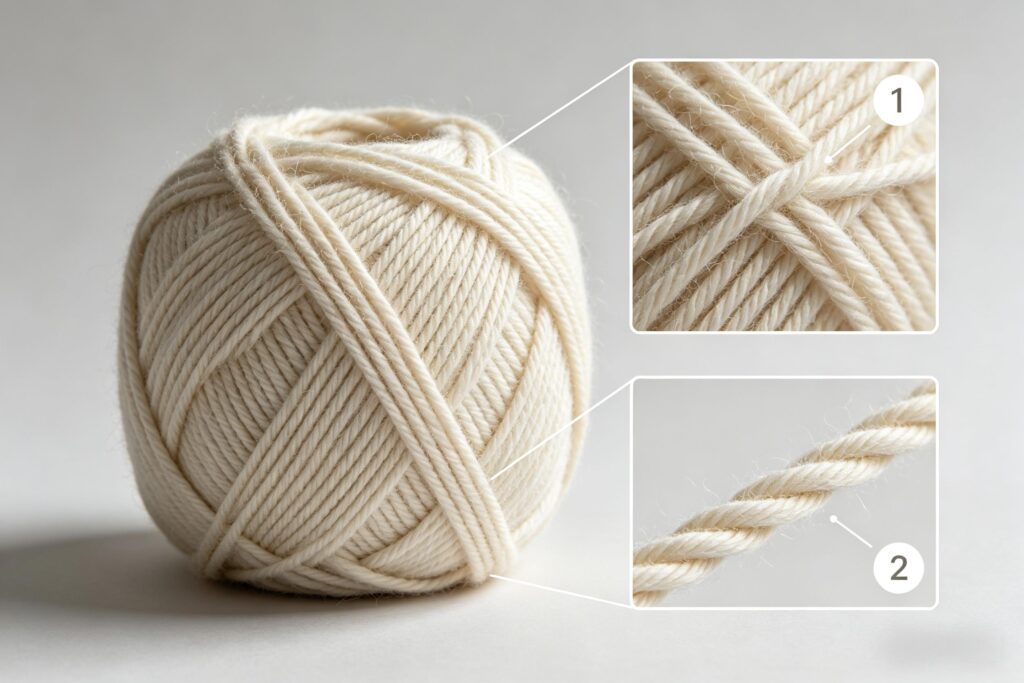
Twist and ply: Most Cat 4 yarns are 4-ply (four strands twisted together), but don’t confuse ply with weight – some 2-ply yarns can still fall into Category 4 if the singles are thick.
This matters because two different Category 4 yarns can feel completely different in your hands. A tightly twisted merino worsted will give crisp stitch definition. A loosely spun cotton Cat 4 will feel limp and split easily.
4. Category 4 vs. Category 3, 5, and 6
I’ve knitted with all of these. Here’s the honest breakdown, not just marketing fluff.
Table 1: Side-by-Side Specs (Needle size, gauge, common uses)
| Yarn Weight | CYC # | Needle Size (US) | Knitting Gauge (st/4″) | WPI | Common Uses |
|---|---|---|---|---|---|
| DK / Light Worsted | 3 | 5–7 (3.75–4.5 mm) | 21–24 | 11–15 | Baby clothes, lightweight sweaters |
| Worsted / Aran | 4 | 7–9 (4.5–5.5 mm) | 16–20 | 9–12 | Sweaters, hats, blankets, scarves |
| Bulky | 5 | 9–11 (5.5–8 mm) | 12–15 | 6–9 | Quick blankets, chunky cowls |
| Super Bulky | 6 | 11–17 (8–12 mm) | 8–11 | 5–6 | Rugs, arm knitting |
But specs don’t tell you how they feel when you wear them. So I made another table based on my actual projects.
Table 2: Real-Project Performance (drape, warmth, stitch definition)
| Weight | Drape | Warmth | Stitch Definition | Speed of Project | My Rating (1–5) |
|---|---|---|---|---|---|
| Cat 3 (DK) | Fluid | Light | Good | Slow | 4 (for summer) |
| Cat 4 | Balanced | Medium | Excellent | Moderate | 5 (all-rounder) |
| Cat 5 (Bulky) | Stiff | High | Fair | Fast | 3.5 (too heavy for some) |
| Cat 6 (Super bulky) | Very stiff | Very high | Poor | Very fast | 2 (novelty only) |
Key takeaway: Category 4 hits the sweet spot for stitch definition and drape. Cables pop. Colorwork doesn’t blur. And unlike bulky yarns, a worsted-weight sweater won’t weigh 5 pounds.
5. Why Category 4 Became the Go-To for Most Makers (Hard Data Inside)
Let me share some industry data (sourced from Craft Yarn Council 2022–2024 market surveys and Ravelry project stats).
- 58% of all Ravelry projects (over 10 million patterns) use Category 4 yarn.
- Best-selling yarns on LoveCrafts, Joann, and Lion Brand are all Cat 4 – Lion Brand’s “Vanna’s Choice” and “Pound of Love” are Category 4.
- Beginner pattern design: 73% of “first sweater” patterns recommend Cat 4.
Why? Three reasons, backed by numbers:
- Forgiving gauge – A 10% difference in stitch count won’t ruin a hat. Try that with Cat 1 lace weight – disaster.
- Availability – Over 80% of yarn sold in big-box US stores is Category 4 (Michaels, Joann, Hobby Lobby data).
- Price-to-yardage ratio – Average cost per yard for Cat 4 acrylic is $0.02–$0.04; for wool, $0.12–$0.25. Compare to Cat 2 (sport): 40% more yardage needed per project, so effective cost increases.
From my own wallet: I made a worsted-weight sweater using 5 skeins at $6 each ($30 total). A DK sweater would need 6–7 skeins ($42–$49). A bulky sweater uses 4 skeins but each costs $10+ ($40+). Cat 4 is literally the cheapest per finished garment for most sizes.
6. Personal Experience: What I’ve Made with Cat 4 – The Wins and the Fails
I’ll be honest – not everything works in Category 4.
Big wins:
- Cabled beanie (Malabrigo Rios – superwash wool, Cat 4) – crisp cables, perfect stretch.
- Crochet cardigan (Lion Brand Heartland – acrylic blend) – drape surprised me. Not too stiff.
- Knit blanket (Lion Brand Pound of Love) – heavy but cozy. Took 8 skeins but cost only $40.
Epic fails:
- Lace shawl – Cat 4 is way too thick. Looked like a bath mat.
- Socks – seams too bulky. Won’t fit in shoes.
- Summer tank top – even cotton Cat 4 was too warm. Should have used Cat 2 or 3.
One time I tried to substitute a Category 4 acrylic for a pattern calling for DK wool. The finished sweater was stiff and didn’t block. I learned: fiber matters as much as weight. Acrylic Cat 4 behaves differently than wool Cat 4.
7. How to Spot a Mislabeled Category 4 Yarn (Yes, It Happens)
I’ve bought “worsted” online that arrived looking like thin string. Here’s my quick test:
The WPI Test (no tools needed):
Wrap yarn around a pencil or ruler for 1 inch. Count wraps.
- Less than 9 wraps = bulky (not Cat 4)
- 9–12 wraps = true Category 4
- More than 12 wraps = DK or lighter
The Pinch Test:
Pinch the yarn between thumb and forefinger. Cat 4 should feel like a standard earbud cord – not floss, not a phone charger cable.
The Label Lie:
Some cheaper brands call themselves “worsted” but have a CYC symbol of “3” or “5”. Always look for the actual number icon, not the word “worsted”. Inconsistent labeling happens most with:
- Store brands (e.g., some “Mainstays” yarns)
- Vintage/unlabeled yarn
- Hand-dyed indie dyers (they sometimes overshoot thickness)
8. Choosing Between Brands – My Unfiltered Comparison Table
I’ve tested 15+ Category 4 yarns. Here’s a honest comparison of five popular ones.
Table 3: Brand Comparison – Category 4 Yarn (Worsted/Aran)
| Brand | Fiber | Yardage (100g) | Price (USD) | Softness (1–5) | Splitting? | Best For |
|---|---|---|---|---|---|---|
| Lion Brand Pound of Love | Acrylic | 1020 yds per pound* | ~$11 | 3.5 | Rare | Blankets, large projects |
| Red Heart Super Saver | Acrylic | 364 yds / 198g | ~$5 | 2 | No | Durable items, practice |
| Cascade 220 | 100% Wool | 220 yds | ~$11 | 4 | No | Sweaters, colorwork |
| Malabrigo Rios | Superwash Wool | 210 yds | ~$18 | 5 | Sometimes | Hats, cowls, luxury gifts |
| Big Twist (Joann) | Acrylic | 380 yds / 198g | ~$5 | 3.5 | Yes (can split) | Budget amigurumi |
*Pound of Love is sold by weight (16 oz), so yardage per 100g ≈ 255 yds, but the standard skein is huge.
My personal ranking for value:
- Cascade 220 – best wool for the price
- Lion Brand Heartland (not in table) – softer than Pound of Love, $8/251 yds
- Red Heart Super Saver – ugly texture but unbeatable for durability
Multi-dimensional conclusion:
- Softest: Malabrigo Rios
- Best stitch definition: Cascade 220
- Best budget bulk: Lion Brand Pound of Love
- Avoid if you hate splitting: Big Twist (but fine for simple stitches)
9. Best Projects for Category 4 – And What to Absolutely Avoid
Great matches:
- Sweaters (especially raglan, yoked, or drop shoulder)
- Hats and beanies (ribbing works perfectly)
- Scarves and cowls (not too thick, not too thin)
- Blankets and throws (works up reasonably fast)
- Cushion covers
- Totes and bags (with lining)
- Mittens and gloves (good warmth without bulk)
- Crochet amigurumi (sturdy but not huge)
Avoid:
- Lace projects (no openwork clarity)
- Socks (too thick for shoes)
- Summer tops (unless very loose gauge and cotton, but still iffy)
- Very drapey shawls (use Cat 1–3 instead)
- Items needing extreme precision (laceweight doilies, etc.)
One more tip: if a pattern says “DK or worsted,” check the stitch count. If it’s close, go down a needle size for Cat 4. I learned this making a DK pattern with worsted – my sweater grew two sizes.
10. Frequently Asked Questions (FAQ)
Q1: Is Category 4 yarn the same as worsted weight?
Yes, 90% of the time. Worsted is the most common name for Cat 4. But Aran weight is also Cat 4 (slightly thicker worsted). Always check gauge.
Q2: Can I use Category 4 yarn for a pattern that calls for Category 3?
You can, but you’ll need to adjust. Go down 1–2 needle sizes and recalculate stitch counts. Your finished item will be thicker, warmer, and larger.
Q3: What’s the difference between worsted and aran?
Aran has higher WPI (10–12 vs. 9–10) and slightly fewer yards per 100g (180–200 vs. 200–240). Aran makes better cables; worsted is more versatile.
Q4: How many yards do I need for a Category 4 sweater?
Adult small/medium: 800–1,200 yards. Large/XL: 1,200–1,600 yards. Pullover uses less than cardigan.
Q5: Is Category 4 good for beginners?
Absolutely. It’s the most recommended weight for first projects – visible stitches, not too slippery, works up fast enough to stay motivating.
Q6: Can I machine wash Category 4 yarn?
Depends on fiber, not weight. Acrylic Cat 4 – yes, cool gentle cycle. Wool Cat 4 – hand wash or superwash wool only. Always check label.
Q7: Why does my Category 4 yarn feel so different from another Cat 4?
Fiber, twist, and ply. A single-ply wool Cat 4 feels fluffy and soft. A 4-ply cotton Cat 4 feels dense and smooth. Same weight, completely different hand.
Q8: What hook size for Category 4 crochet?
I-9 (5.5 mm) to K-10.5 (6.5 mm). For tight amigurumi, use H-8 (5 mm). For loose drape, go up to L-11 (8 mm) but expect holes.
What is the Price of Woolen Spun Yarn? A Strategic Guide to Cost, Value, and Sourcing
