
Article Outline
- A Personal Note: How I Learned to Stop Ignoring DTY
- The Simple Answer: What DTY Fabric Is Actually Made Of
- Raw Material Deep Dive – The Polyester Predecessor (POY)
- 3.1 Why POY isn’t fabric-ready yet
- 3.2 Intrinsic viscosity and its hidden role
- The Twist That Changes Everything – Texturizing Explained
- 4.1 False-twist texturizing in plain language
- 4.2 What happens to the filament structure
- Raw Material Data Table – From POY to DTY to Fabric
- DTY vs. Other Knits & Wovens
- What I’ve Personally Seen Go Wrong (And Right) With DTY Sourcing
- Why Composition Alone Doesn’t Tell You Quality – The Additive Story
- DTY Blends: Polyester + Cotton, Spandex, Nylon – How They Change Things
- What You Actually Need to Check Before Buying
- FAQ – 8 Real Questions from Buyers & Production People
DTY Fabric Exposed: What It’s Really Made Of (And Why Most Buyers Get It Wrong)
1. A Personal Note: How I Learned to Stop Ignoring DTY
A few years ago, I was visiting a knit factory in northern Vietnam – not a huge one, maybe sixty circular knitting machines. The owner showed me two rolls of black fabric. Same weight, same finish, looked identical in the photo. One stretched beautifully and felt soft. The other was stiff, rough, and after three washes, it looked like a wrinkled mess.
“Same DTY fabric,” he said. “Different suppliers.”
That was the day I realized I didn’t actually understand what DTY fabric was made of. I knew DTY stood for draw textured yarn. But knowing the acronym and really understanding the raw material composition – those are two different planets.
2. The Simple Answer: What DTY Fabric Is Actually Made Of
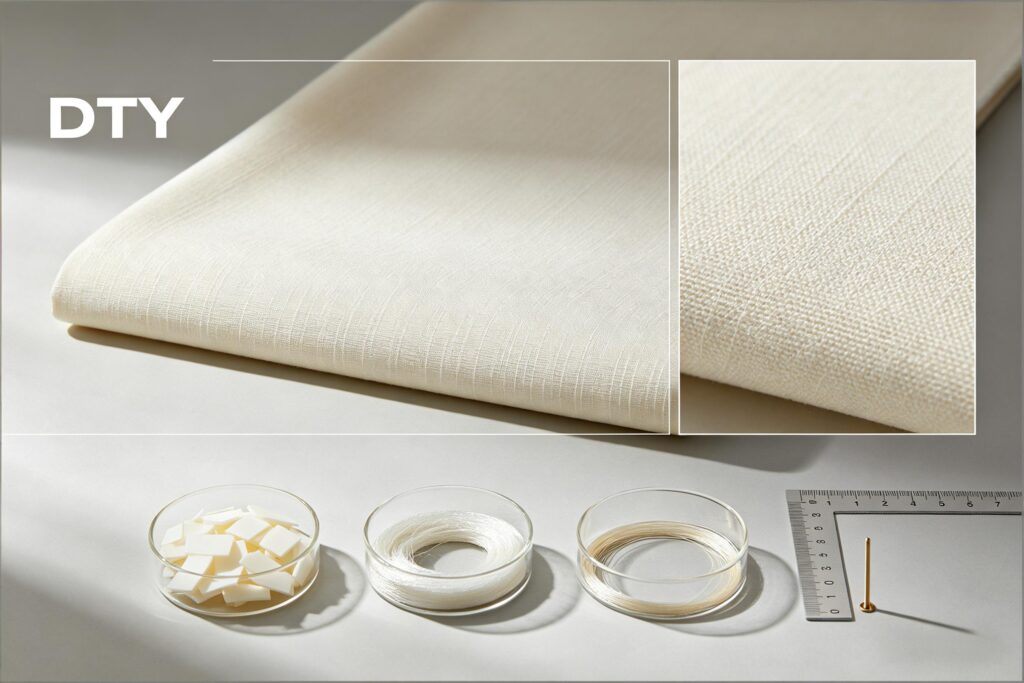
At its heart, DTY fabric is made from polyester – specifically, a special type of polyester filament called draw textured yarn.
But here’s what most people miss: the yarn itself has already been through a mechanical transformation before it ever touches a knitting or weaving machine. You’re not using standard polyester. You’re using polyester that’s been stretched, twisted, heat-set, and untwisted to create built-in bulk and stretch.
In composition terms:
- Base polymer: >99% polyethylene terephthalate (PET)
- Additives: TiO₂ (delusterant), sometimes antistatic agents or color masterbatch
- Physical form: Multi-filament (many individual tiny filaments twisted together)
No cotton. No wool. No spandex unless it’s a blend. Pure DTY fabric is 100% polyester. But the feel and performance come from how that polyester was mechanically processed.
I remember telling a client once that DTY fabric was “just polyester” and watching his face fall. Then I showed him a piece of DTY jersey next to a piece of standard flat polyester woven fabric. He touched both and stopped arguing. Same chemistry. Completely different hand feel.
3. Raw Material Deep Dive – The Polyester Predecessor (POY)
You can’t understand DTY fabric without understanding POY – partially oriented yarn. POY is the starting point.
3.1 Why POY isn’t fabric-ready yet
POY comes directly from melt spinning. The polyester chips are melted, extruded through a spinneret, cooled, and wound onto packages. But here’s the key: POY is only partially stretched. Its molecules have some orientation, but not enough to give the yarn good strength or stability.
If you tried to knit or weave with POY directly, you’d get:
- High shrinkage (like >50% in hot water)
- Low strength
- A weird, limp, rubbery feel
I’ve seen a small weaver in Pakistan try this once as a “cost saving” experiment. It ended badly. The fabric distorted after the first dyeing cycle and the entire roll went to waste.
3.2 Intrinsic viscosity and its hidden role
POY is made from PET chips with a specific intrinsic viscosity (IV). For DTY production, the standard IV is usually between 0.62 and 0.65 dL/g. Too low (below 0.58) and the yarn breaks constantly during texturizing. Too high (above 0.68) and the yarn becomes too stiff – you lose the softness that makes DTY desirable.
I didn’t pay attention to IV numbers for years. Then a Turkish supplier sent me a DTY fabric sample that felt almost like nylon – very soft, almost too slick. Turns out, they had used a lower IV base (0.60) and a different texturizing speed. The fabric was beautiful but shrank 12% in the first wash. IV matters more than most buyers realize.
4. The Twist That Changes Everything – Texturizing Explained
This is where the magic (and the confusion) happens.
4.1 False-twist texturizing in plain language
DTY is made using a false-twist texturizing machine. Here’s what happens inside:
- POY is pulled off the package and passes through a heating zone (around 170–190°C).
- While hot, it’s twisted very tightly – hundreds of twists per meter.
- The twisted yarn cools down in a cooling zone, “freezing” the twist in place.
- Then the yarn passes through a second heater (for set yarn) or skips it (for raw yarn).
- Finally, the yarn is untwisted before winding.
Wait – untwisted? Yes. That’s the “false” part. The yarn ends up with no net twist, but each individual filament has been permanently deformed into a crimped, coiled, spring-like shape. Those crimps give DTY its bulk, its softness, and its stretch.
I used to think texturizing was just adding a wavy shape. It’s not. It’s literally changing how the polymer molecules are arranged inside each filament. When you feel a good-quality DTY fabric, the softness isn’t a coating or a chemical – it’s a mechanical memory.
4.2 What happens to the filament structure
Under a microscope, a normal flat polyester filament looks like a smooth glass rod. A DTY filament looks like a corkscrew or a slinky that’s been stretched and released.
This structure does three things:
- Bulk: More air between filaments → warmer, softer fabric
- Stretch: Usually 15–30% elongation at break compared to <10% for flat yarn
- Cover: Hides the individual filament lines better than flat yarn
A German textile engineer once described it to me as “giving the yarn a memory of being coiled.” That image has stuck with me.
5. Raw Material Data Table – From POY to DTY to Fabric
Here’s a data table based on typical values I’ve collected from Chinese, Indian, and Turkish production records (normalized for 150 denier as reference):
| Parameter | POY (input) | DTY (output) | Change | Why It Matters |
|---|---|---|---|---|
| Tenacity (cN/tex) | 35–38 | 40–45 | +15–20% | Stronger fabric |
| Elongation (%) | 120–140 | 18–30 | -80% | Less stretching during use |
| Boiling water shrinkage (%) | 55–65 | 4–8 | -90% | Fabric stays stable in washing |
| Crimp contraction (%) | 0 | 12–20 | +100% | Bulk & softness |
| Denier variation (CV%) | 0.8–1.2 | 1.5–2.5 | slightly higher | consistent dyeing |
| Residual torque (tpi) | 0 | 0 (false-twist) | N/A | No skewing in knit |
What I personally take from this table: DTY sacrifices some uniformity (denier CV gets a bit worse) to gain bulk, stability, and softness. If you need perfect uniformity, stay with flat yarn. But if you want hand feel, DTY is the way.
6. DTY vs. Other Knits & Wovens
This is the part I wish someone had shown me on a single page years ago.
| Property | DTY Knit (100% Polyester) | Flat Yarn Knit | Cotton Jersey | Nylon Knit | Polyester Woven (flat) |
|---|---|---|---|---|---|
| Softness (hand feel) | 8/10 | 3/10 | 9/10 | 9/10 | 2/10 |
| Stretch (without spandex) | 20–30% | 5–10% | 15–20% | 25–35% | <5% |
| Wrinkle resistance | 9/10 | 9/10 | 4/10 | 8/10 | 7/10 |
| Moisture absorption | 1/10 | 1/10 | 8/10 | 3/10 | 1/10 |
| Abrasion resistance | 8/10 | 7/10 | 3/10 | 7/10 | 9/10 |
| Cost (relative) | medium | low | high | very high | low |
| Typical use | sportswear, t-shirts, lining | industrial, cheap lining | premium tees | activewear, hosiery | outerwear, bags |
What this table tells me (based on my own sampling): DTY knit is the best all-rounder if you want softness and durability without paying nylon prices. But it’s terrible for moisture absorption – so don’t use it for heavy sweat applications unless you add a wicking finish or blend it.
7. What I’ve Personally Seen Go Wrong (And Right) With DTY Sourcing
Let me tell you two quick stories.
Wrong: A sportswear brand in the UK ordered DTY fabric for summer running tops. The fabric looked fine in the lab dip. But once production started, the garments felt heavy and didn’t breathe. They had accidentally specified “raw DTY” (no second heater) instead of “set DTY.” Raw DTY has higher bulk and stretch but also higher residual shrinkage. After three washes, the tops had shrunk a full size. The brand ended up scrapping 8,000 pieces.
Right: A mattress cover manufacturer in Thailand switched from open-end spun polyester to a fine-denier DTY knit (75 denier, 144 filaments). They increased production speed by 18% because DTY ran cleaner on their circular knitting machines. Fewer yarn breaks, less dust. Their customer complained about nothing – which, in that industry, is the highest compliment.
My takeaway after watching this play out a dozen times: DTY is not “better” than flat yarn or cotton. It’s different. You need to match the DTY construction (denier, filament count, set vs. raw, luster) to the end use. Otherwise, you end up with expensive scrap.
8. Why Composition Alone Doesn’t Tell You Quality – The Additive Story
Here’s something most fabric sellers won’t volunteer: DTY can have up to 2–3% additives by weight that completely change its behavior.
Common additives in DTY:
- TiO₂ (titanium dioxide): Controls luster. Semi-dull (0.3–0.5%) is standard. Full-dull (1.5–2.5%) is used for very matte fabrics.
- Antistatic agents: Usually applied as a finish (not embedded). Washes off after 5–10 cycles – something I learned the hard way when a client complained about static in winter.
- Spin finishes: Lubricants that help knitting. Too much, and dyeing problems show up (white spots, uneven take-up).
I once tested two DTY fabrics from different Chinese mills, both labeled “100% polyester semi-dull 150/48.” Same denier, same filament count. One dyed flawlessly. The other had tiny white specks all over. The difference? The second mill had used a cheap spin finish that wasn’t fully removed during pre-treatment. The composition was identical. The quality was not.
So when you ask “what is DTY fabric made of,” remember: the answer includes invisible additives and finishes that won’t show up on a basic composition test.
9. DTY Blends: Polyester + Cotton, Spandex, Nylon – How They Change Things
Pure DTY fabric is already useful. But blends are where it gets interesting.
DTY + Cotton (CVC or 50/50)
- The cotton adds moisture absorption and a more natural feel.
- The DTY adds wrinkle resistance and durability.
- What I’ve noticed: this blend is great for polo shirts, but only if the cotton is combed. Cheap carded cotton + DTY feels rough and pills badly.
DTY + Spandex (typically 5–20%)
- Stretch goes from 25% to 50–80%.
- But spandex degrades with chlorine, heat, and UV. I’ve seen DTY/spandex leggings turn into baggy messes after 20 washes.
- Best use: occasional-wear fashion, not daily performance gear.
DTY + Nylon (rare, but exists)
- Nylon adds abrasion resistance and a silkier feel.
- Dyeing is tricky – nylon and polyester take dye differently. Two-bath dyeing adds cost.
- A niche I’ve personally sourced for: premium swimwear linings.
My rule of thumb: If you need performance, stick with pure DTY plus a wicking finish. If you need comfort, blend with cotton. If you need extreme stretch, add spandex – but warn your customer about the lifespan trade-off.
10.What You Actually Need to Check Before Buying
After writing all of this – and after years of making my own mistakes with DTY – here’s what I actually check before I buy any DTY fabric now:
- Denier and filament count. A 150/48 will feel different from a 150/144 (more filaments = softer).
- Set or raw. Always ask. For garments that get washed, use set DTY. For stuffed toys or non-washed applications, raw can work.
- Luster level. Semi-dull is the default. Full-dull hides defects better but feels slightly drier.
- Spin finish quality. You can’t test this easily, but you can ask for a dye test sample before bulk.
- Shrinkage warranty. 4–6% is good. Over 8% is risky for apparel.
DTY fabric isn’t mysterious. It’s polyester that’s been mechanically bullied into a softer, bulkier form. But the details – the ones that happen before the yarn ever reaches the knitting machine – are what separate a fabric that sells from one that ends up in the discount bin.
FAQ – 8 Real Questions from Buyers & Production People
1. Is DTY fabric the same as polyester fabric?
Not exactly. All DTY fabric is polyester, but not all polyester fabric is DTY. Standard polyester fabric uses flat yarn, which feels smoother and stiffer. DTY has been texturized for bulk and softness.
2. Does DTY fabric pill easily?
High-quality DTY (with good twist and proper heat-setting) resists pilling better than cheap spun polyester or low-twist DTY. But any polyester can pill if the filaments are short or poorly bonded. I’ve seen DTY pill badly only from mills using recycled content with uncontrolled IV.
3. Can DTY fabric be 100% recycled?
Yes and no. You can make DTY from recycled PET chips (bottle-grade or fiber-grade). But most recycled DTY today is only 30–50% recycled content because fully recycled filament has lower tenacity and breaks more in texturizing.
4. Why does some DTY fabric feel like cotton?
Texture, not composition. High-filament-count DTY (e.g., 150/144 instead of 150/48) creates a much softer, fuller hand feel that mimics cotton. But it won’t absorb moisture like cotton.
5. What’s the difference between DTY nylon and DTY polyester?
DTY nylon exists but is less common. Nylon has lower modulus (feels silkier, stretches more easily) but costs 2–3× more than polyester DTY and has worse UV resistance. Most “DTY” sold in volume is polyester.
6. Can I wash DTY fabric in hot water?
Set DTY can handle 40–60°C (104–140°F) without major shrinkage. Raw DTY should only be cold-washed. Always check whether your DTY was “set” (second heater used) or “unjacketed” (no second heater).
7. How do I test if a fabric is real DTY or fake?
Pull a single yarn and stretch it. Real DTY has noticeable stretch (20–30%) and springs back partially. Flat polyester yarn has almost no stretch. Also, burn a few fibers – polyester melts and smells sweet, while cotton or wool chars.
8. Why is Vietnamese/Indian DTY sometimes cheaper than Chinese?
Usually because of filament count and twist levels. Vietnamese and Indian mills often produce DTY with lower filament counts (e.g., 150/36 instead of 150/96) and less twist, which reduces cost but makes the fabric stiffer and less durable. You’re not getting a bargain – you’re getting a different spec.
