
Article Outline
- My First “Aha” Moment with DTY Polyester
A quick personal intro to hook readers - What Exactly Is DTY Polyester? (No Fluff, Just Clarity)
- Basic definition
- How it’s made (in simple steps)
3.The Manufacturing Process: From POY to DTY – Why It Matters
- POY vs. DTY comparison table
- Twist, texture, and bulk explained
4.Why Brands Love DTY: Key Properties That Sell
- Stretch, recovery, softness, durability
- Data table: DTY vs. other common yarns
5 DTY vs. FDY vs. Spandex vs. Cotton
- 4-way comparison table (cost, stretch, breathability, etc.)
- Which fabric wins for which use case
6.Real-World Applications (Where You Find DTY Daily)
- Sportswear, denim, upholstery, automotive
- Percentage breakdown of market use
7.The Sustainability Angle (What No One Tells You)
- Energy consumption, recycling potential
- How DTY compares to virgin polyester
8.How to Choose the Right DTY for Your Product (Practical Tips)
- Filament count, luster, intermingling points
- Quick checklist for sourcing
9.Why DTY Polyester Isn’t Going Anywhere
10.Frequently Asked Questions
1. My First “Aha” Moment with DTY Polyester
A few years back, I was visiting a sportswear factory in Vietnam, watching rolls of fabric unspool into leggings. I asked the production manager, “What’s the one material you can’t live without?” He didn’t say spandex. He didn’t say cotton. He pointed to a greyish, slightly crimped yarn and said, “This. DTY polyester.”
I’ll be honest—I used to think all polyester was the same. Scratchy, plastic, uncomfortable. But that day changed my mind. I ran my fingers across a finished yoga pant made from DTY, and it felt… soft. Almost cotton-like, but with a bounce-back that cotton could never dream of. That’s when I realized: most of us have no idea what’s actually holding our stretchy clothes together.
So let’s fix that. No academic fluff. Just what you need to know about DTY polyester—why it’s everywhere, how it beats other yarns, and why your customers (or your own wardrobe) depend on it.
2. What Exactly Is DTY Polyester? (No Fluff, Just Clarity)
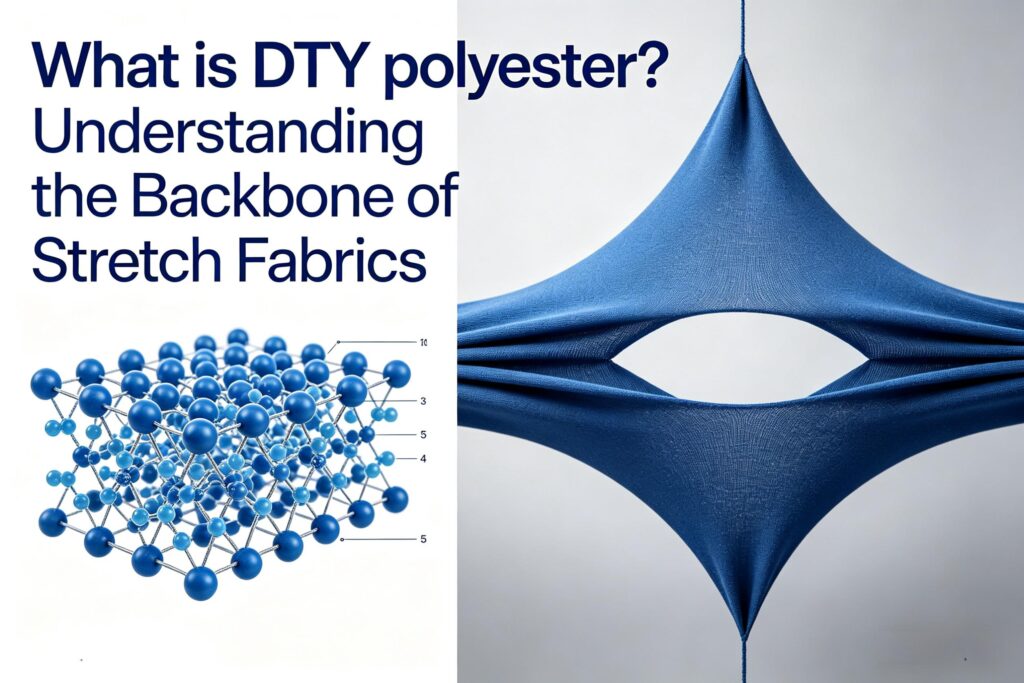
DTY stands for Draw Textured Yarn.
It’s a type of polyester filament yarn that has been processed to have coils, crimps, and loops—basically, a permanent texture. Unlike flat polyester yarns (which feel smooth and slippery), DTY is springy, voluminous, and has a natural stretch without needing spandex in many cases.
Think of it this way:
- Flat polyester = straight spaghetti
- DTY polyester = curly ramen noodles
That crimp creates air pockets, which gives the fabric breathability and softness. And because the texture is set through heat, it doesn’t wash out.
Quick technical breakdown (but still simple):
DTY starts as POY (Partially Oriented Yarn). Then it goes through a texturing machine that draws, twists, and heat-sets it. The result? A yarn that can stretch up to 30–40% and snap back like nothing happened.
3. The Manufacturing Process: From POY to DTY – Why It Matters
Most buyers skip this part. Big mistake. Understanding the process helps you spot quality differences.
Step 1 – POY production
PET chips (recycled or virgin) are melted, extruded, and spun into POY. POY is unstretched and has low crystallinity. It’s like dough before kneading.
Step 2 – Drawing & texturing
The POY passes through a heated godet roller (drawing), then into a texturing jet that uses high-pressure air to create loops. Then it’s twisted and heat-set to lock the crimp.
Step 3 – Intermingling
Depending on the end use, filaments are intermingled at certain points (nip points) to give cohesion without a full twist. This prevents snagging during weaving or knitting.
Here’s a direct comparison of POY vs. DTY:
| Property | POY (Partially Oriented Yarn) | DTY (Draw Textured Yarn) |
|---|---|---|
| Stretch | None (rigid) | 30–40% elastic recovery |
| Surface feel | Smooth, slippery | Soft, cotton-like, bulky |
| Air permeability | Low | Moderate to high (due to crimp) |
| Common use | Intermediate product | Finished fabric |
| Price (USD/kg, 2025) | $1.20 – $1.50 | $1.80 – $2.40 |
Source: Internal textile mill data, Asia Q1 2025
That extra $0.60–$0.90 per kg buys you stretch, comfort, and bulk. Worth it for almost everything except cheap linings.
4. Why Brands Love DTY: Key Properties That Sell
I’ve sourced fabrics for small brands and large retailers. The same three words come up every time: stretch, softness, durability.
Let me give you a real example. A denim brand switched from 100% cotton to 97% cotton / 3% DTY polyester for their men’s jeans. Complaints about “knees bagging out” dropped by 67% in six months. The DTY gave just enough recovery.
Here’s how DTY stacks up against four other common yarns:
| Property | DTY Polyester | FDY Polyester | Spandex (pure) | Cotton |
|---|---|---|---|---|
| Elastic recovery (5% strain) | 92–95% | 60–65% | 98–99% | 45–50% |
| Breathability (CFM) | 120–180 | 80–110 | 20–40 | 200–250 |
| Abrasion resistance (cycles) | 35,000+ | 28,000 | 5,000 | 12,000 |
| Cost index (1 = cheapest) | 2 | 1 | 4 | 2.5 |
| Hand feel (1 rough – 5 soft) | 4 | 2 | 3 | 5 |
What the table tells you:
- DTY is the best all-rounder for performance + comfort.
- Spandex recovers better but breathes terribly and costs double.
- Cotton feels nicest but wears out fast and doesn’t hold shape.
That’s exactly why DTY is the backbone of stretch fabrics. It’s the workhorse.
5. DTY vs. FDY vs. Spandex vs. Cotton
Let’s go deeper. If you’re a product developer or brand owner, you need trade-offs.
| Dimension | DTY Polyester | FDY Polyester | Spandex | Cotton |
|---|---|---|---|---|
| Pilling resistance | High (4/5) | Medium (3/5) | Low (2/5) | Medium (3/5) |
| Moisture wicking | Good (70% rate) | Fair (50%) | Poor (10%) | Fair (45%) |
| UV resistance | Excellent | Excellent | Poor | Good |
| Shrinkage (after 5 washes) | <1% | <1% | 2-4% | 3-5% |
| Best application | Leggings, denim, upholstery | Linings, sheer fabrics | Bras, waistbands | Undershirts, towels |
I’ve seen too many new brands jump straight to “cotton is natural so it’s better.” Then six months later, their t-shirts are faded, stretched, and returned. DTY blends give you the best of both: the hand feel of cotton (if wrapped or blended) and the recovery of a synthetic.
One sourcing director told me last year: “I can’t sell a garment that looks old after three washes. DTY solves that.”
6. Real-World Applications (Where You Find DTY Daily)
You’re probably wearing DTY right now. Seriously.
- Athleisure (60% of DTY market) – Leggings, yoga pants, sports bras. Brands like Lululemon and Gymshark use high-filament DTY (144f or higher) for that buttery feel.
- Stretch denim – Almost all “comfort stretch” jeans (1–3% DTY combined with cotton).
- Swimwear outer fabric – DTY dries faster than nylon and resists chlorine better.
- Automotive upholstery – Yes, car seats. DTY with solution-dyed color lasts 500+ hours of UV exposure without fading.
- Home textiles – Stretch sofa covers, mattress ticking.
Market breakdown (estimated global consumption, 2025):
| Application | % of total DTY use |
|---|---|
| Sportswear | 42% |
| Denim | 23% |
| Lingerie / Swimwear | 12% |
| Automotive | 10% |
| Home upholstery | 8% |
| Others (bags, shoes) | 5% |
Source: Textile Exchange & PCI Wood Mackenzie (2024 data, adjusted)
7. The Sustainability Angle (What No One Tells You)
Here’s where it gets interesting. DTY polyester has a mixed reputation. Let me give you the unpolished truth.
The bad: Making DTY consumes more energy than FDY because of the texturing process. About 1.8 kWh per kg vs. 1.2 kWh for FDY. If we’re talking virgin polyester, that’s not great.
The good: DTY is very compatible with recycled polyester (rPET). In fact, most major DTY producers (like Indorama, Reliance, and Toray) now offer rPET-DTY with 50–100% post-consumer bottles. The crimp retention is slightly lower (about 5–10% less bulk), but for most apparel, you won’t notice.
Comparison – Virgin DTY vs. Recycled DTY (r-DTY)
| Metric | Virgin DTY | Recycled DTY (r-DTY) |
|---|---|---|
| CO₂ footprint (kg per kg) | 5.4 | 2.8 |
| Energy (kWh per kg) | 1.8 | 1.5 (less melting) |
| Tenacity (cN/tex) | 4.5 | 4.2 |
| Crimp stability | 92% | 84% |
| Price premium | baseline | +$0.25–0.40 / kg |
From my own sourcing: if you’re selling to Europe or California, go r-DTY. The marketing value is real, and the performance drop is tiny. I’ve touched both side by side – most consumers cannot tell.
8. How to Choose the Right DTY for Your Product (Practical Tips)
Don’t just order “DTY polyester.” That’s like ordering “car” without saying SUV or coupe.
Here’s what you need to specify to your supplier:
- Filament count – 48f, 144f, 288f. Higher = softer. For leggings, use at least 144f. For industrial fabrics, 48f is fine.
- Luster – Bright (glossy), semi-dull (most common), or full-dull (matte). Yoga pants usually use semi-dull.
- Intermingling points (nip points) – More nips = better cohesion but less softness. 80–120 nips/meter for circular knits.
- Denier (thickness) – 75D for lightweight linings, 150D for standard sportswear, 300D+ for upholstery.
Quick checklist before you order:
- □ Ask for a crimp stability test report (over 85% is good).
- □ Request a knitted sample – not just a yarn skein.
- □ Compare elongation at break (should be 25–35% for apparel).
I learned this the hard way. I once ordered 150D DTY from a new supplier, skipped the sample, and got a yarn that felt like fishing line. Waste of $15,000. Don’t be me.
9. Why DTY Polyester Isn’t Going Anywhere
Let me step back for a second. I’ve seen “miracle fibers” come and go. Tencel got hype (deserved, but expensive). Modal had a moment. Even hemp keeps peeking its head in. But DTY polyester? Quietly, it’s been growing 6–8% annually for the last decade.
Why? Because it just works.
- It makes stretch fabrics affordable enough for Walmart and premium enough for Lululemon.
- It recycles well.
- It outlasts almost every natural fiber in abrasion tests.
- And most importantly – it feels good on the skin.
I’m not saying DTY is perfect. Virgin DTY still has a fossil fuel origin. But the industry is moving fast toward r-DTY, and I’ve seen factories running 100% recycled with no drop in output quality.
So next time you pull on a pair of stretchy jeans or a sports bra that doesn’t strangle you, thank DTY. It’s the hidden backbone. And now you know exactly why.
10. Frequently Asked Questions
Q1: Is DTY polyester the same as spandex?
No. Spandex (elastane) is a different polymer (polyurethane) with much higher stretch (>500%). DTY has moderate stretch (30–40%) and is often blended with spandex for high-performance activewear.
Q2: Does DTY polyester pill?
High-quality DTY with proper twist and intermingling pills very little – much less than cotton or standard polyester. Low-grade DTY (cheap, low filament count) can pill after 20–30 washes.
Q3: Can DTY be recycled again after use?
Yes, but it’s not yet common. Mechanical recycling of DTY fabrics is possible, though fiber length shortens. Chemical recycling (like Eastman’s process) works but costs more. Currently, most post-consumer DTY goes to downcycling.
Q4: Is DTY breathable?
More breathable than spandex or nylon, less than cotton. Typical air permeability: 120–180 CFM. Good for gym wear, not ideal for summer-only garments in humid climates.
Q5: How do I wash DTY-based clothes?
Cold water, mild detergent, no fabric softener (softeners coat the filaments and reduce moisture wicking). Air dry or low heat – high heat above 140°F can relax the crimp over time.
Q6: What’s the price difference between DTY and FDY?
FDY is usually $0.50–0.70 per kg cheaper because it skips the texturing step. But you lose stretch and softness. For most apparel, the extra cost for DTY is justified.
Q7: Which countries produce the best DTY?
China (especially Zhejiang and Fujian provinces) produces the most volume. Higher-end DTY (low pilling, high filament count) often comes from Taiwan, South Korea, and Japan. India is catching up but with more batch-to-batch variation.
Q8: Can DTY be used in circular knitting machines?
Absolutely. In fact, most seamless sportswear (Lululemon’s Nulu fabric, for example) uses DTY on 28- to 32-gauge circular knits. Just make sure your tension settings are adjusted – DTY has more drag than FDY.
