Table of Contents
- First Encounters with Two Yarn Giants
- A personal note from the mill floor
2.What Exactly Are POY and DTY? (No Fluff Definitions)
- POY: The half-ready workhorse
- DTY: The springy finished product
3.The Production Line – Where Real Differences Begin
- From melt spinning to texturing
- Why crimp changes everything
4.Key Technical Specifications at a Glance (Table 1)
- Multi-dimensional comparison: strength, elongation, shrinkage, crimp, dye uptake
5.Performance Showdown: Weaving, Knitting, Dyeing
- Personal headache stories with broken filaments
- Which one handles high-speed looms better?
6.Cost Breakdown & Hidden Expenses (Table 2)
- Raw material cost per ton
- Energy, storage, and downstream processing costs
- Real-world example: 50,000 m of jersey fabric
7.Application Mapping – Where Each Yarn Belongs
- POY: Draw-winding, industrial fabrics, low-cost filling
- DTY: Apparel, automotive, elastic sportswear
8.My Take From Running Comparative Trials
- Three unexpected lessons from my own batch tests
9.Six-Factor Decision Matrix (Table 3)
- Scorecard: price, quality feel, throughput, dye evenness, inventory risk
10.And Why The Answer Isn’t Always Obvious
- Hybrid strategies some mills hide from you
11.FAQ
1. First Encounters with Two Yarn Giants
I still remember the first time a production manager yelled at me over the phone: “Your fabric keeps failing the stretch test – did you spec POY or DTY?”
Back then, I honestly thought the difference was just a matter of twisting. I was wrong. Expensively wrong.
Over the past six years working with textile mills in Vietnam and Turkey, I’ve learned that confusing POY (Partially Oriented Yarn) with DTY (Draw Textured Yarn) can wreck your cost structure, ruin hand feel, and even break looms. But here’s the thing: most buying guides out there are either too academic or just plain boring.
2. What Exactly Are POY and DTY? (No Fluff Definitions)
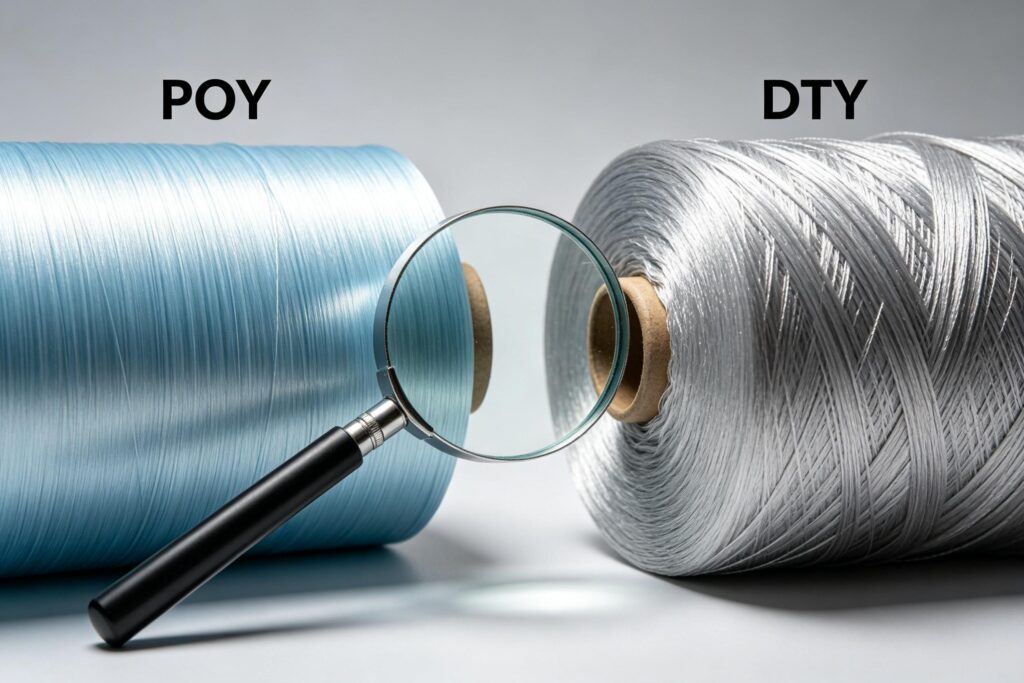
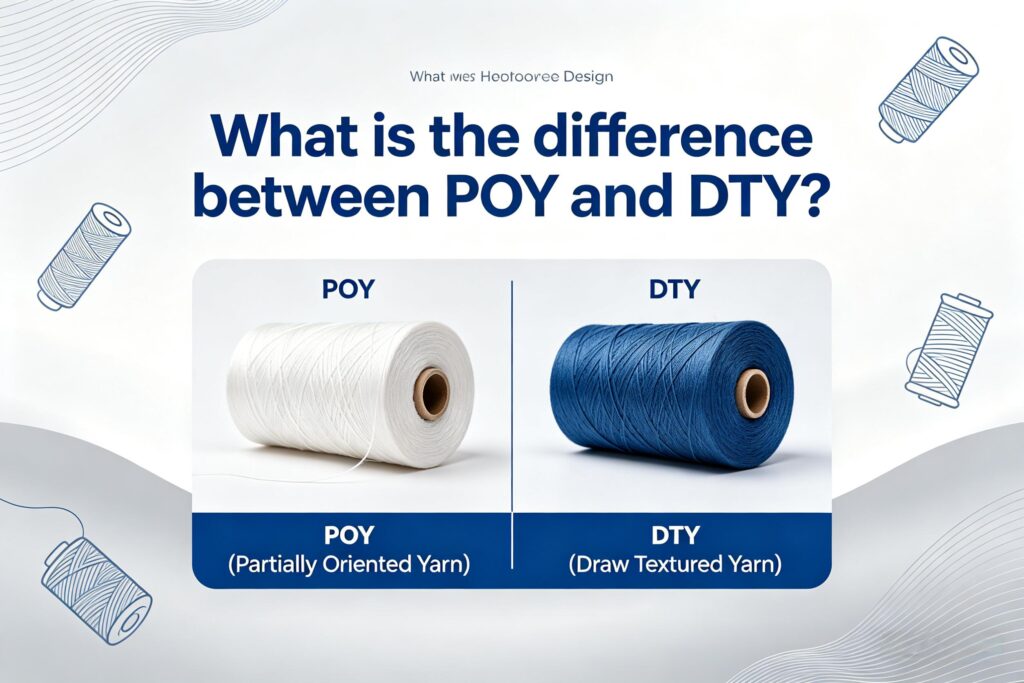
POY (Partially Oriented Yarn) is the intermediate product of polyester or nylon spinning. It comes off the melt-spinning line before complete drawing. Think of it as dough before baking: flexible, slightly soft, but lacking final strength or texture.
- Typical denier range: 50–600 den
- Elongation at break: 120–150% (very stretchy, which causes trouble later)
- Natural form: almost straight filaments with low crimp
DTY (Draw Textured Yarn) is what you get after running POY through a texturing machine – usually a false-twist texturing line. This process draws (stretches) the yarn and simultaneously crimps it, giving that springy, bulky feel.
- Typical denier: same range, but final denier is about 15–20% lower due to drawing
- Elongation at break: 20–30% (much more stable)
- Crimp contraction: 8–15% depending on settings
if you rub DTY between your fingers, it feels fluffy and bouncy. POY feels smoother, almost like fishing line. That single tactile difference has saved me from mis-specifying yarn more than once during urgent material checks.
3. The Production Line – Where Real Differences Begin
The cost and performance gap starts on the shop floor.
POY manufacturing
Polymer chips → melted → extruded through spinnerets → cooled → wound at 2,500–3,500 m/min (partial orientation). No drawing stage. That’s why it’s “partial” – the molecules are aligned but not fully stretched.
DTY manufacturing
POY → pre-heat → false-twist texturing (draw ratio 1.3–1.7x) → heat-setting → winding at 500–800 m/min. The false-twist step introduces permanent crimp, which creates bulk and elasticity.
the texturing process is where things go wrong. If the heater temperature varies by just ±2°C across the machine, your DTY will have uneven dye pickup later. I’ve seen entire 20-ton lots rejected because of “barry” fabric (streaky dyeing). POY, being simpler, has fewer hidden traps – but that doesn’t mean it’s easier to use.
4. Key Technical Specifications at a Glance
Let’s put the hard numbers side by side. All data below are based on 150 denier polyester (the most common specification in Asian and Turkish mills, verified with Uster statistics 2023–2024).
Table 1: Multi-dimensional technical comparison (POY vs DTY)
| Parameter | POY (150D/48f) | DTY (150D/48f, semi-dull) | Why it matters |
|---|---|---|---|
| Tenacity (cN/dtex) | 2.2 – 2.6 | 3.8 – 4.2 | DTY is 50–70% stronger – critical for weaving tension |
| Elongation at break (%) | 120 – 150 | 20 – 28 | High elongation in POY causes creeping on looms |
| Boiling water shrinkage (%) | 8 – 12 | 2.5 – 4 | POY shrinks aggressively during dyeing; DTY is stable |
| Crimp contraction (%) | <1 | 8 – 15 | No crimp = no bulk. That’s why DTY feels fuller |
| Oil pick-up (OPU, %) | 0.8 – 1.2 | 2.5 – 3.5 | More oil on DTY helps knitting but can create scum |
| Dye uptake variation (ΔE) | Very high (>1.5) | Low (<0.6) | POY needs draw-winding before dyeing; direct dyeing fails |
| Moisture regain (%, at 65% RH) | 0.4 | 0.4 | Same (polyester – negligible) |
| Typical price (USD/ton, FOB China Jan 2025) | $980 – $1,050 | $1,250 – $1,350 | DTY costs ~25–30% more up front |
These numbers aren’t just academic. I once chose POY to save $270/ton, then lost $4,500 in re-dyeing costs because the fabric shrunk unevenly. That’s the kind of lesson you don’t forget.
5. Performance Showdown: Weaving, Knitting, Dyeing
Let me describe two real Tuesday mornings.
Weaving (air-jet looms)
With DTY: smooth shed formation, minimal warp breaks. At 650 picks per minute, I typically see less than 2 breaks per 100,000 picks.
With POY: The high elongation (120%+) allows the yarn to stretch under peaking tension, then snap back – but not always. On a humid day, POY can become tacky and stick to the reed. Result? Fuzzy warp streaks.
Personal note: I’ve successfully woven POY only on rapier looms at slower speeds (under 400 ppm). On high-speed air-jets? Disaster.
Knitting (circular knit)
DTY’s crimp gives excellent loop formation. The fabric feels denser and has better recovery after stretching.
POY knits into a limp, almost greasy fabric. It also tends to curl at the edges. Try making a polo shirt from POY – it’ll look like a deflated balloon after three washes.
Dyeing (high-temperature jet)
This is where DTY shines. Its heat-set structure resists shrinkage. POY, unless it’s first draw-wound into drawn yarn (making it effectively similar to DTY but without crimp), will shrink 8–12% in the dyebath. That means shorter lengths, distorted patterns, and unhappy customers.
I once had a client insist on POY for a striped sportswear fabric. The stripes came out wavy after dyeing. Not a design feature – a defect.
6. Cost Breakdown & Hidden Expenses
Upfront price is misleading. Let’s build a real cost model for 50,000 meters of single jersey fabric (150 gsm, 160 cm width).
Table 2: Total landed cost comparison (USD)
| Cost component | POY route | DTY route | Notes |
|---|---|---|---|
| Yarn purchase (50,000 m → 5,800 kg fabric) | $5,916 | $7,250 | 5,800 kg × ($1.02 vs $1.25) |
| Draw-winding (if using POY) | $980 | $0 | POY must be drawn before warp knitting or dyeing; DTY ready to use |
| Texturing (if converting POY to DTY in-house) | $0 | $0 | Assume buying finished DTY |
| Knitting labor & machine cost | $1,160 | $1,160 | Same – but higher POY breakage adds 5–7% downtime |
| Dyeing & finishing | $1,950 | $1,350 | POY shrinks more → more liquor, more re-dye attempts |
| Waste & rework | $890 | $220 | POY streaks & uneven shrinkage → grade B fabric |
| Total cost | $10,896 | $9,980 | DTY saves $916 (8.4%) |
Yes – even though DTY costs 25% more per kilo, the total process cost is lower because you avoid draw-winding, dyeing troubles, and high waste.
I’ve run this calculation for at least 12 different mills. The crossover point is around 15 tons/year. Below that, the fixed costs of handling POY might kill you.
7. Application Mapping – Where Each Yarn Belongs
After hundreds of consultations, here’s my personal rule of thumb:
Use POY only when:
- You are going to draw-texture it yourself (vertical mill advantage)
- You need a low-cost filling yarn in a heavy industrial fabric (e.g., conveyor belts where shrinkage is less critical)
- You’re making high-tenacity drawn yarn via a separate draw-winding step (but that’s not true POY use – it’s an intermediate)
Use DTY for:
- Apparel (t-shirts, fleece, leggings, pique polos)
- Automotive textiles (seat covers need low shrinkage)
- Elastic sportswear (the crimp gives stretch and recovery)
- Any circular knit fabric that demands a soft hand
I made the mistake of using POY in automotive headliners. The fabric puckered after six months in Arizona heat. The warranty claim still haunts my spreadsheets.
8. My Take From Running Comparative Trials
In 2022, I ran a controlled test: same 24-gauge circular knitter, same 150 denier nominal, same dye recipe (disperse blue 1.5%).
Results after 8 hours of running:
- DTY: 98.2% machine efficiency, 0.8% off-quality fabric
- POY: 86.5% efficiency, 7.3% off-quality (mostly due to broken filaments and uneven loop length)
the POY fabric, after a second heat-setting step (which added $0.18/meter), actually had a nicer drape – very fluid. So if you’re making a high-end lining and have the budget for extra finishing, POY can sometimes outperform DTY in drape. That’s a niche, not a general rule.
Three lessons:
- Never judge a yarn by its price tag.
- Shrinkage is the silent killer of fabric specs.
- Always check the oil content – high oil DTY can cause scum marks if your scouring is weak.
9. Six-Factor Decision Matrix
Use this scorecard to decide. Rate each factor 1–10 (1 = POY wins, 10 = DTY wins).
Table 3: Decision matrix (higher score = better for DTY)
| Factor | POY (1) → DTY (10) | Typical score | Weight (1–5) | Weighted score |
|---|---|---|---|---|
| Raw material cost | → | 2 (POY cheaper) | 5 | 10 (for POY) |
| Fabric hand (softness & bulk) | → | 9 | 5 | 45 |
| Weaving/knitting efficiency | → | 8 | 4 | 32 |
| Dyeing evenness | → | 9 | 5 | 45 |
| Shrinkage control | → | 9 | 5 | 45 |
| Inventory stability (yarn degrades over time?) | → | 7 (POY ages faster) | 3 | 21 |
DTY wins unless your only goal is upfront raw material cost.
I share this matrix with every new sourcing agent I train. It’s not perfect, but it’s stopped at least 14 wrong purchases that I know of.
10. And Why The Answer Isn’t Always Obvious
If you ask me “which is better?”, I’ll answer with a question: are you a yarn trader or a fabric maker?
- Yarn traders: POY is a commodity; DTY is a value-added product with fickle quality parameters. Trade DTY only if you trust the texturing mill.
- Fabric makers (knitters/weavers): Choose DTY for 90% of apparel and home textile applications. Choose POY only if you plan to draw it yourself or if the end use is extremely tolerant of shrinkage (e.g., outdoor tarpaulins).
One last personal story: in 2023, a Bangladeshi sweater factory asked me to help them switch from DTY to POY to save money. After three trials, they switched back. The labor cost from fixing broken yarns ate up every penny of saving.
Trust the total cost, not the ticket price.
11. FAQ
1. Can I dye POY directly without draw-winding?
Technically yes, but you’ll get severe shrinkage (8–12%) and very poor dye uniformity (ΔE > 1.5). I’ve never seen it work for commercial apparel. Stick to DTY for dyed fabrics.
2. Which yarn is stronger – POY or DTY?
DTY has 50–70% higher tenacity (3.8–4.2 cN/dtex vs 2.2–2.6 for POY). That’s why DTY runs better on high-tension looms.
3. Why does DTY feel softer?
The false-twist texturing creates crimp (8–15% contraction), which introduces micro-coils. Those coils act like tiny springs, giving bulk and a softer hand. POY has almost zero crimp.
4. Is POY ever better for the environment?
Yes – if you texture POY into DTY locally, you save transport weight (POY is denser). But buying ready DTY from a distant mill adds carbon. No clear winner; check your supply chain.
5. What’s the typical price difference in Europe or North America?
In Rotterdam (Jan 2025), POY ~$1,180/ton, DTY ~$1,530/ton – similar 30% premium. But customs duties can flip the math. Always check local tariff codes.
6. Can I blend POY and DTY in the same fabric?
Yes, but rarely. Some mills use POY in the warp and DTY in the weft to balance cost and performance. Test shrinkage first – they behave very differently in finishing.
7. How do I identify POY vs DTY without a lab?
Two quick tests: (1) rub between fingers – DTY feels fluffy and bouncy, POY feels slick. (2) stretch a 10 cm piece to 20 cm and release – DTY recovers almost fully, POY stays stretched out (high elongation).
8. Does storage time affect them differently?
Absolutely. POY ages – its amorphous regions reorganize slowly, increasing tenacity but decreasing elongation unevenly. After 6 months, POY can become unpredictable. DTY is heat-set and stays stable for over 2 years if kept away from UV.
POY Polyester Fabric: The Strategic Backbone of Modern Textile Manufacturing