
Article Outline
- Why “Average Price” Is Almost a Useless Question
- The Simple Answer – What Polyester Costs Right Now (With Real Numbers)
- The Raw Materials That Drive Everything – PTA and MEG
- 3.1 How crude oil trickles down to polyester chips
- 3.2 The China effect no one can ignore
- Price Breakdown by Polyester Form (The Table You Actually Need)
- Virgin vs. Recycled, Fiber vs. Resin, Spot vs. Contract
- What I’ve Personally Paid Over the Last Three Years (And What I Learned)
- Hidden Costs That Ruin Your “Good Price”
- 7.1 Logistics and container rates – the silent killer
- 7.2 Payment terms and currency swings
- 7.3 Quality variation that doesn’t show on a quote
- Regional Price Differences – Where to Buy and Where to Avoid
- How to Negotiate Polyester Prices Without Looking Like an Amateur
- Stop Asking for “Average” – Start Asking the Right Questions
- FAQ – 8 Random Questions Buyers Keep Asking Me
1. Why “Average Price” Is Almost a Useless Question
I’ve been asked “what’s the average price of polyester” maybe two hundred times over the last few years. By factory owners in Bangladesh. By startups in Nigeria trying to make their first nonwoven roll. By a guy in Poland who was convinced he was overpaying.
And every single time, I have to stop myself from sighing.
The problem isn’t the question itself. The problem is that an “average” price for polyester is like asking for the average temperature of a planet – technically calculable, but completely useless for deciding what jacket to wear today.
I’ve bought polyester at $0.85/kg and I’ve bought it at $1.60/kg in the same year. Same supplier. Same spec. The difference was timing, oil prices, and a container shortage that no one saw coming.
So instead of giving you a single number that will be wrong by the time you finish reading this sentence, I’m going to show you how polyester pricing actually works. What drives it. How it varies by form, by region, and by your own negotiation skills. And I’ll give you real numbers from my own purchase records – not theoretical averages.
2. The Simple Answer – What Polyester Costs Right Now (With Real Numbers)
Let me give you a snapshot. These are actual transaction prices I’ve seen in Q1 and Q2 of this year (2025, as I write this), normalized for standard-grade materials, FOB main port unless noted.
| Product | Grade / Spec | Price Range (USD/ton) | Typical Origin |
|---|---|---|---|
| PET chips (bottle grade) | standard, virgin | 880 – 1,050 | China, Southeast Asia |
| PET chips (fiber grade) | semi-dull, 0.64 IV | 850 – 1,020 | China, India, Vietnam |
| rPET chips (hot-wash clear) | non-food, L>72 | 780 – 980 | Southeast Asia, Mexico |
| POY (150/48) | semi-dull | 1,050 – 1,250 | China, India |
| DTY (150/48, set) | AA grade | 1,350 – 1,600 | China, Vietnam, Turkey |
| PSF (1.4D x 38mm) | virgin, semi-dull | 1,100 – 1,300 | India, China, South Korea |
Now, before you screenshot this and treat it as gospel – don’t. These numbers move. Last year, at the same time, PET chips were $150/ton higher. The year before that, they were $200 lower.
What I want you to take away is the spread between forms, not the absolute numbers. PSF is almost always $200–300/ton higher than chips because you’re paying for the spinning and cutting. DTY adds another $200–300 on top of POY because of the texturizing step.
3. The Raw Materials That Drive Everything – PTA and MEG
You can’t understand polyester pricing without understanding what polyester is made from.
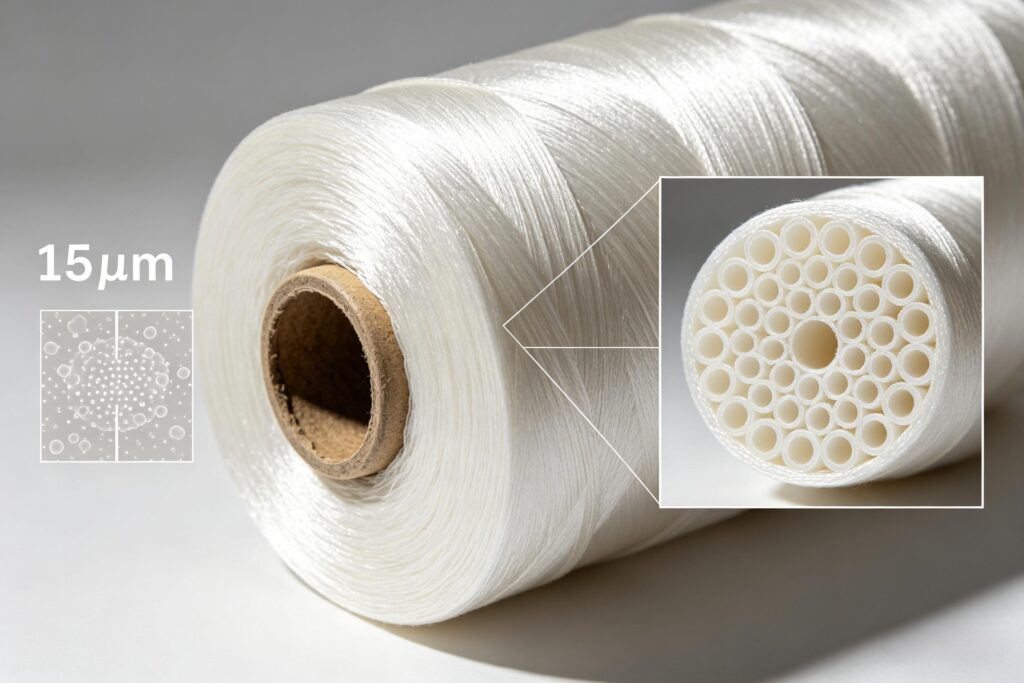
Polyester (PET) is a polymer created by reacting purified terephthalic acid (PTA) and monoethylene glycol (MEG). Roughly speaking, 1 ton of PET uses about 0.86 tons of PTA and 0.34 tons of MEG. The rest is mostly water and a tiny bit of catalyst.
3.1 How crude oil trickles down to polyester chips
PTA comes from paraxylene (PX), which comes from naphtha or xylene, which comes from crude oil. MEG comes from ethylene, which also comes from naphtha or natural gas.
So when crude oil jumps $10/barrel, PTA and MEG don’t jump by the same percentage – but they do jump. I’ve watched the lag effect many times. Oil spikes on a Monday. By Thursday or Friday, PTA futures in China start moving. About two weeks later, polyester chip offers go up.
Here’s a rough correlation I’ve observed (not financial advice, just my notes):
- Oil at $70–75/bbl → PET chips around $850–950/ton
- Oil at $80–90/bbl → PET chips around $950–1,100/ton
- Oil at $95+ → PET chips often $1,150–1,300/ton
But here’s the catch: polyester prices are sticky downward and fast upward. When oil drops, mills hold out for a week or two hoping buyers don’t notice. When oil rises, prices change the next day. That asymmetry has cost me money more than once.
3.2 The China effect no one can ignore
China produces more than 70% of the world’s polyester. I’m not guessing – that’s from PCI Wood Mackenzie data. What happens in China doesn’t just influence global prices. It determines them.
When Chinese mills run at 85% utilization, prices are stable or soft. When they cut rates below 70%, prices firm up because buyers panic. When they raise rates above 90%, oversuppression can push prices down even if oil is high.
I learned this the hard way in 2023. I delayed a purchase because oil was dropping, assuming polyester would follow. But Chinese mills had just announced production cuts for maintenance. Prices went up instead of down. I ended up paying $70/ton more than if I had bought two weeks earlier.
4. Price Breakdown by Polyester Form (The Table You Actually Need)
Let me give you a more detailed breakdown. This is based on my own purchasing across 2024 and early 2025, plus conversations with four other buyers who shared their numbers. All prices are in USD/ton, FOB main port (China for most, except where noted).
| Form | Specification | Typical Price (low) | Typical Price (high) | What’s Included |
|---|---|---|---|---|
| PET bottle chips | 0.80 IV, clear, virgin | 880 | 1,050 | standard packaging (1.2t bags) |
| PET fiber chips | 0.64 IV, semi-dull | 850 | 1,020 | same |
| rPET chips | clear, hot-washed, non-food | 750 | 950 | may have slight yellow tint |
| PET sheet grade | IV 0.75+, high clarity | 980 | 1,200 | lower acetaldehyde |
| POY (150/48) | semi-dull, AA | 1,050 | 1,250 | waxed for knitting |
| FDY (150/48) | semi-dull, AA | 1,180 | 1,380 | lower elongation, tighter denier |
| DTY (150/48) | set, AA | 1,350 | 1,600 | 18–22% crimp contraction |
| PSF (1.4D) | virgin, semi-dull | 1,100 | 1,300 | baling included |
| PSF (black) | 1.4D, dope-dyed | 1,350 | 1,550 | color added during spinning |
| Nonwoven staple (6D) | semi-dull, low crimp | 1,050 | 1,220 | larger denier, less expensive |
What jumps out at me: The step from chip to fiber is roughly $200–250/ton for POY and closer to $300/ton for PSF. The step from POY to DTY is another $250–350. If someone offers you DTY for only $150 above POY, either they’re running very efficiently or they’re cutting corners on texturizing (like skipping the second heater).
5.Virgin vs. Recycled, Fiber vs. Resin, Spot vs. Contract
This is the comparison I wish someone had drawn for me years ago.
| Comparison Dimension | Option A | Option B | Price Difference (A vs B) | My Take |
|---|---|---|---|---|
| Virgin PET chips vs. rPET chips (clear) | $930 | $840 | +$90 | rPET worth it if color and gels are controlled |
| Fiber-grade chips vs. bottle-grade chips | $920 | $950 | -$30 | fiber grade slightly cheaper usually |
| POY vs. FDY (same denier) | $1,150 | $1,280 | -$130 | FDY costs more but saves downstream drawing |
| Spot purchase vs. quarterly contract (stable market) | market +0% | market -5% | spot is higher | Contracts protect you in rising markets, hurt in falling |
| Spot vs. contract (volatile market) | risky | safer | depends | I’ve been burned both ways |
| Chinese origin vs. Indian origin (POY) | $1,100 | $1,050 | +$50 | China is often slightly cleaner, India cheaper but variable |
| Small quantity (5 tons) vs. full container (24 tons) | +15–25% | base | large is cheaper | The premium for small lots is brutal |
Here’s what I’ve personally settled into: For standard POY and DTY, I use quarterly contracts for about 60% of my volume and buy the rest spot when prices dip. For rPET chips, I never do contracts longer than three months because the quality changes too much between batches. For PSF, I buy spot almost exclusively – the market is too volatile to lock in.
6. What I’ve Personally Paid Over the Last Three Years (And What I Learned)
I dug up my old purchase records for this section because I wanted to be honest, not theoretical.
| Date (approx) | Product | Price (USD/ton) | Notes |
|---|---|---|---|
| early 2022 | PET chips (fiber) | 1,280 | Peak post-COVID madness |
| mid 2022 | POY (150/48) | 1,550 | I almost cried paying this |
| late 2022 | rPET chips | 1,050 | Still high but dropping |
| early 2023 | PET chips | 950 | Back to normal range |
| mid 2023 | DTY (150/48) | 1,420 | Reasonable |
| early 2024 | PET chips | 920 | Nice dip, bought extra |
| late 2024 | POY | 1,100 | Container rates spiked, paid 100 more for freight |
| early 2025 | rPET chips | 830 | Best price I’ve seen in years |
Timing matters more than negotiation. I’m a decent negotiator, but the difference between paying $1,550 and $1,100 for POY wasn’t my skill – it was waiting eight months. The second lesson: don’t get used to today’s price. Polyester is a commodity. Commodities move.
7. Hidden Costs That Ruin Your “Good Price”
You find a supplier offering POY at $1,080 when everyone else is at $1,150. Great price, right? Maybe. Or maybe not. Here’s where the hidden costs live.
7.1 Logistics and container rates – the silent killer
In 2021 and again in late 2024, container freight from Shanghai to Europe hit $8,000–10,000 per 40-foot container. On a 24-ton load, that’s $330–420 per ton – on top of your FOB price. A “cheap” POY at $1,050 becomes $1,380 landed.
Always ask for CIF (cost, insurance, freight) quotes if you don’t control shipping. And track container rates yourself. I use Freightos’s Baltic Index. It’s free and it’s saved me from nasty surprises.
7.2 Payment terms and currency swings
A supplier offers 30% deposit, 70% against documents. Another offers 100% L/C at sight. The first one looks easier. But if your currency drops 5% between deposit and balance payment, that “easy” term just cost you.
I got burned in 2022 when the Turkish lira dropped while I had a deposit outstanding. My landed cost went up 11% overnight. Now I negotiate everything in USD with clear L/C terms.
7.3 Quality variation that doesn’t show on a quote
The worst hidden cost: a batch that looks fine on paper but runs poorly on your line.
I bought rPET chips at $820/ton from a new supplier in Vietnam. Great price. But when I ran them, my screen pack pressure rose twice as fast as normal. I was changing filters every 18 hours instead of 48. The extra downtime and labor ate up the $80/ton I thought I was saving.
Now I factor in a “quality risk” buffer when comparing prices. A $1,100 POY from a known supplier is sometimes cheaper than a $1,030 POY from an unknown one – after you account for the risk of breaks, rejects, and downtime.
8. Regional Price Differences – Where to Buy and Where to Avoid
Based on my own purchasing and data shared by four other buyers (two in Europe, one in Turkey, one in Colombia), here’s a regional breakdown for polyester chips and POY as of this year.
| Region | PET Chips (USD/ton) | POY 150/48 (USD/ton) | Pros | Cons |
|---|---|---|---|---|
| China | 880 – 950 | 1,050 – 1,150 | Volume, consistent quality at top mills | Geopolitical risk, freight distances |
| India | 850 – 930 | 1,020 – 1,120 | Often cheapest, improving quality | Logistics slower, documentation inconsistent |
| Vietnam | 860 – 950 | 1,080 – 1,180 | Good balance of price and quality | Smaller mills, less capacity for large orders |
| Turkey | 950 – 1,050 | 1,150 – 1,250 | No long sea freight for Europe | More expensive, currency volatility |
| USA (domestic, not export) | 1,000 – 1,150 | 1,250 – 1,400 | Fast lead time, reliable | Expensive for export markets |
| South Korea | 980 – 1,080 | 1,200 – 1,320 | Excellent quality, high-tech | Premium price |
My personal play: For chips, I buy from Vietnam or India depending on who has the better price that month. For POY and DTY, I stick with China or Turkey (if my customer is in Europe). I avoid Indian POY after two bad experiences with broken filaments.
9. How to Negotiate Polyester Prices Without Looking Like an Amateur
I’ve been on both sides of the negotiation table. Here’s what works.
Do your homework first. Know the current PTA and MEG prices. Know the operating rates in China. If you walk in asking for a discount without knowing where the market is, you look like an amateur. I use ICIS or Platts for benchmarks – sometimes the free summaries are enough.
Buy 2–3 months ahead of peak season. Everyone wants POY in February for spring/summer garments. Demand pushes prices up. Buy in December or January instead.
Offer faster payment for a discount. Some suppliers will knock off 2–3% if you pay 100% L/C at sight instead of 30/70. Cash flow is valuable to them.
Ask about off-grade or B-grade material. If your product isn’t picky (dark colors, nonwoven filler, strapping), you can save 15–25% on off-grade polyester. I’ve done this for black PSF and saved $200/ton. Just test it first.
Don’t threaten to walk unless you mean it. I’ve seen buyers play tough and lose a good supplier. Commodity margins are thin. Suppliers will call your bluff.
10.Stop Asking for “Average” – Start Asking the Right Questions
If you take nothing else from this article, take this: there is no single average price for polyester.
The price depends on what form you’re buying (chips, POY, DTY, PSF), where you’re buying it from, how much you’re buying, when you’re buying it, and whether you’ve done your homework.
What you should ask instead:
- What’s the current PTA and MEG price?
- What are Chinese polyester mills doing with their operating rates?
- What’s the spread between chips and POY right now?
- What are container rates to my port?
Those questions will get you closer to a real answer than any “average” ever will.
I’ve paid too much for polyester. I’ve paid too little and gotten bad material. But over time, I’ve learned that the best price isn’t the lowest number on a quote – it’s the price that gives you consistent quality, predictable lead times, and a supplier who picks up the phone when something goes wrong.
FAQ – 8 Random Questions Buyers Keep Asking Me
1. Why did polyester prices double in 2021?
Three reasons: crude oil spiked after COVID demand returned, China cut operating rates due to energy restrictions, and container freight exploded. It was a perfect storm. I don’t expect that to repeat soon, but commodities are unpredictable.
2. Is recycled polyester cheaper than virgin?
Usually yes – $50–150/ton cheaper for comparable grades. But not always. In late 2022, rPET was actually more expensive than virgin in Europe because demand for recycled content outstripped supply. Always check both.
3. Can I get the same price for 5 tons as 25 tons?
Almost never. Small lots (anything under 10 tons) carry a premium of 15–25% because the supplier has to break a pallet, repackage, or handle special logistics. Consolidate your orders or find a trader who groups small buyers.
4. How often should I ask for new quotes?
Weekly if you’re buying spot. Monthly if you’re on contract but monitoring. Polyester prices can move 2–3% in a week. I’ve seen them move 8% in ten days. The buyers who check quotes often are the ones who catch the dips.
5. Do Chinese polyester prices include VAT?
No. Export prices from China are FOB without VAT (value-added tax). Domestic Chinese prices include 13% VAT. Make sure your quote specifies “export” or “VAT excluded” – otherwise you’re comparing apples to oranges.
6. Why is Turkish polyester sometimes cheaper than Chinese for Europe?
Freight. Shipping from Turkey to Germany or Poland costs a fraction of shipping from China. Even if the Turkish mill’s FOB price is $100/ton higher, the landed cost can be lower because freight is $300/ton less. Always calculate delivered price.
7. What’s a fair payment term for first-time polyester buyers?
30% deposit, 70% L/C at sight is standard. Don’t accept 100% upfront. Don’t accept “only T/T” from an unknown supplier. If they push back hard, find someone else. There are plenty of suppliers.
8. How do I know if a supplier’s price is real or a bait-and-switch?
Ask for a proforma invoice with a batch number. Real suppliers will issue one. Scammers will give excuses. Also, check if their price is wildly below everyone else’s. A $200/ton difference when the market is stable is a red flag. I’ve seen this three times – it was a scam every single time.
Recycled Polyester Filament Yarn Wholesale: The 2026 Sourcing Guide You Actually Need
