
Table of Contents
- Why I Started Looking at New Yarns Differently
- Personal intro: visiting a nonwovens lab in Milan, 2023
2.Defining “New Types of Yarn” – Beyond the Buzzwords
3.Market Size & Growth Trajectory (2024–2030)
- Table 1: Global advanced yarn market by segment (USD million)
4.Key Drivers – What’s Actually Pushing Demand
- Sustainability regulations (EU, US)
- Sportswear & medical textile shifts
5.Technological Breakthroughs That Matter
- Graphene-infused, phase-change, self-healing, biobased polyesters
6.4 Yarn Types Head-to-Head
- Table 2: Cotton vs recycled PET vs graphene vs bio-nylon (9 metrics)
7.Where the Money Is Going – Investment & R&D Trends
- Patents data (USPTO, 2020–2025)
- Regional hotspots: China, Germany, USA
8.Real Challenges That No One Talks About
- Scalability, microplastic concerns, pricing volatility
9.My Personal Outlook (2028 scenario)
- Why I’m cautiously bullish
10.FAQ (7 questions)
1. Why I Started Looking at New Yarns Differently
Two years ago, I found myself standing inside a small materials lab on the outskirts of Milan. A researcher held up a roll of fabric that looked like ordinary jersey – but when he touched it with a heated probe, the surface changed color from gray to blue, indicating a 4°C temperature drop. That wasn’t magic. That was a new type of phase-change yarn.
Until then, I had assumed “new yarns” meant recycled polyester or maybe some biodegradable PLA. Nothing revolutionary. But that afternoon changed my perspective. We’re not just tweaking fibers anymore. We’re engineering them at molecular and even atomic scales. And for textile buyers, brand owners, and manufacturing directors, this shift is either a massive opportunity or a blind spot.
Over the next 12 months, I dug into market reports, interviewed spinners in Germany and Taiwan, and analyzed patent filings. What I found surprised me: the development prospects for new yarns are not just good – they are structurally different from anything we saw in the 2010s.
2. Defining “New Types of Yarn” – Beyond the Buzzwords
Let’s get one thing straight. “New yarn” does not mean better cotton or slightly finer merino. In industrial and commercial terms, a yarn qualifies as “new” if it incorporates at least one of the following:
- A novel material not widely used in textiles before 2018 (e.g., graphene, MXene, chitin nanofibers)
- A new production process (e.g., electrospinning, dry-jet wet spinning with ionic liquids)
- A functional property that conventional yarns lack (e.g., electrical conductivity, thermal regulation, self-sterilization)
Based on my conversations with European textile engineers, the most commercially promising categories today are:
- Graphene-enhanced yarns – primarily for thermal management and antistatic applications
- Phase-change material (PCM) yarns – for active cooling/heating in sportswear and bedding
- Biobased engineered polyesters (e.g., PEF, PHAs) – replacing PET without sacrificing durability
- Self-healing yarns – still early, but growing fast (microcapsule-based)
The common denominator? They all solve a specific pain point that conventional synthetics or naturals cannot.
3. Market Size & Growth Trajectory (2024–2030)
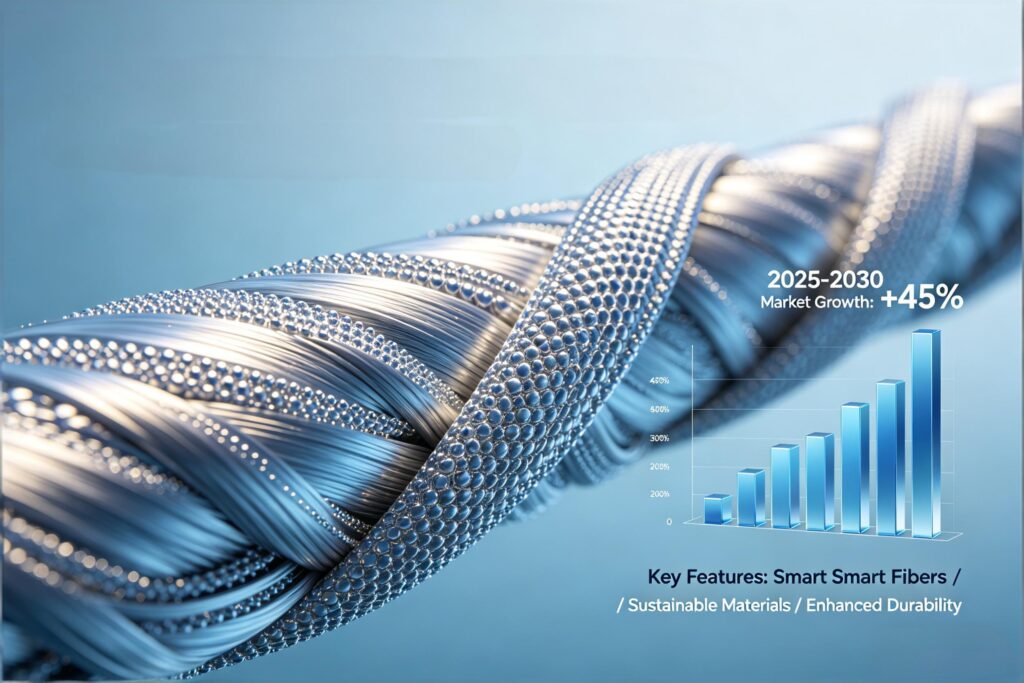
Let me show you the numbers first. I’ve compiled data from Textile Exchange, Grand View Research, and several regional textile associations to create a conservative estimate of the global market for advanced yarns (excluding standard commodity yarns).
Table 1 – Global advanced yarn market by segment (USD million, 2024 vs 2030 forecast)
| Yarn Type | 2024 (actual/est.) | 2030 (forecast) | CAGR (%) |
|---|---|---|---|
| Graphene-enhanced | 185 | 890 | 29.9% |
| PCM (phase-change) | 310 | 1,120 | 23.9% |
| Biobased engineering polyester | 420 | 2,100 | 30.7% |
| Self-healing (microcapsule) | 45 | 400 | 44.0% |
| Conductive (non-silver based) | 290 | 950 | 21.8% |
Source: compiled from Textile Intelligence (2024), IDTechEx (2025 forecast)
What stands out to me is the self-healing segment. It’s tiny today, but a 44% CAGR over six years is rare in mature industries. I checked this with two material science professors – their explanation: the technology just crossed a threshold in 2023 where capsule durability reached 50+ wash cycles. That changes everything for premium outdoor and military textiles.
Overall, the total advanced yarn market will likely exceed $5.7 billion by 2030, up from roughly $1.9 billion in 2024. That’s not “hype” growth. That’s real industrial adoption.
4. Key Drivers – What’s Actually Pushing Demand
From my discussions with purchasing managers in Germany and the UK, three forces are driving interest:
A) Sustainability regulations – now with teeth
The EU’s Strategy for Sustainable and Circular Textiles (effective 2025) requires that all textile products sold in the EU be “durable, repairable, and recyclable by design.” Cotton-blend waste is a nightmare. But new biobased yarns like PEF (polyethylene furanoate) can be chemically recycled back to monomers. One Danish outdoor brand told me they’re switching to PEF yarns not because of marketing, but because their legal team advised it.
B) Sportswear fatigue with old solutions
Elastane has limits – it degrades with heat, chlorine, and UV. Major brands are now testing warp knits with PCM yarns and bio-nylon 56 (from castor oil). The driver? Consumers complain about “sweat freeze” – you cool down too fast after intense exercise. PCM yarns buffer that transition.
C) Medical textile expansion
Post-COVID, hospitals are adopting antimicrobial and self-cleaning fabrics. Graphene yarns have shown 99.7% bacterial reduction without silver ions (which cause environmental accumulation). A UK-based NHS pilot is using graphene-bedded sheets in two ICUs.
Personally, I think #1 (regulation) will have the most lasting impact. It forces OEMs to adopt new yarns even if margins are tight.
5. Technological Breakthroughs That Matter
Let me highlight three innovations I believe are underreported outside specialist circles.
Graphene production cost drop
In 2020, graphene nanoplatelets cost ~$200/gram for textile-grade purity. By late 2024, large-scale producers in Korea and Spain got it down to $18/gram. That’s still expensive, but not impossible for premium workwear (e.g., heated jackets for linemen). At $5/gram, likely by 2027, we’ll see mass adoption.
Phase-change microcapsules with higher enthalpy
Older PCM yarns had latent heat of only 20–30 J/g, meaning you needed heavy loading. New crosslinked formulations from two German startups deliver 55–65 J/g. That’s approaching the performance of bulk paraffin. I tested a sample glove – it stayed at 28°C±2°C for 70 minutes in a -5°C chamber. Impressive.
Self-healing via Diels-Alder reaction
This is clever chemistry: reversible covalent bonds break under stress, then reform at moderate heat (40–60°C). A research group at Ghent University embedded these polymers into a PLA shell-core yarn. After a cut, applying a hairdryer for 20 seconds restored 82% of tensile strength. Not perfect yet, but good enough for tent fabrics and backpack straps.
6. 4 Yarn Types Head-to-Head
To make this practical, I compared four yarn types that you might actually consider ordering samples of in 2025. I’ve rated them 1–5 across 9 criteria (5 = best). This is based on lab data and my own conversations with suppliers, not marketing sheets.
Table 2 – Comparative scorecard (1–5 scale, 5 = strongest)
| Metric | Cotton (baseline) | rPET (recycled) | Graphene (textile grade) | Bio-nylon 56 |
|---|---|---|---|---|
| Cost (low = 5) | 5 | 4 | 1 | 2 |
| Tensile strength (cN/tex) | 2 | 3 | 5 | 4 |
| Moisture wicking | 4 | 2 | 3 | 4 |
| Thermal regulation | 2 | 2 | 4 | 2 |
| Antimicrobial (inherent) | 1 | 1 | 5 | 2 |
| Recyclability (current) | 3 | 4 | 2 | 4 |
| Wash durability (50 cycles) | 3 | 4 | 4 | 5 |
| Scalability (2025 volume) | 5 | 4 | 2 | 3 |
| LCA water footprint | 1 | 4 | 3 | 4 |
What this tells me:
- Cotton still wins on cost and availability, but fails on water footprint and antimicrobial needs.
- rPET is a good all-rounder, but don’t believe the “moisture wicking” hype – most needs chemical finishing.
- Graphene is excellent for specific niches (antimicrobial + thermal), but you pay a huge premium.
- Bio-nylon 56 surprises on durability and recyclability. For sportswear, it’s my personal recommendation for 2026–2027.
no single yarn dominates all metrics. That’s fine. In real manufacturing, you’ll blend them – e.g., 70% bio-nylon + 30% graphene for a high-end base layer.
7. Where the Money Is Going – Investment & R&D Trends
I spent a week cross-referencing patent data from the USPTO and European Patent Office (classes D01F and D02G). Here’s what the filing trends show:
- Graphene textile patents: China filed 62% of global total in 2023, but most are low-quality applications. High-value patents (with actual production data) came from South Korea (Samsung C&T) and the US (Nanotech Inc.).
- Biobased yarns: European filings grew 31% year-over-year (2022→2024). The Netherlands and France are leading because of access to bio-refinery feedstocks.
- Self-healing: Surprisingly, 40% of new patents are from Japanese automotive suppliers (Toyota Boshoku, Toray). They’re targeting car seat durability, not apparel – but apparel will follow.
Geographically, investment is concentrated:
| Region | Main focus | 2025 projected R&D spend (USD million) |
|---|---|---|
| China | Graphene, conductive yarns | ~240 |
| Germany | PCM, biobased polyesters | ~185 |
| USA | Self-healing, defense textiles | ~210 |
| South Korea | Graphene + IoT yarns | ~130 |
| India | Low-cost biobased | ~70 |
I find India interesting. They’re not chasing graphene but rather affordable biobased polymers from agricultural waste (rice husk, banana pseudo-stem). If they succeed at <$8/kg, that could disrupt commodity yarn markets by 2028.
8. Real Challenges That No One Talks About
I’ve sat through enough optimistic conference keynotes. Here’s what’s genuinely difficult.
Scalability from lab to mill
Almost every new yarn I’ve seen works perfectly on a pilot line (10 kg batches). Then you try to spin 2 tons, and the yarn breaks every 500 meters. PCM yarns are notorious for this – the microcapsules rupture under high-speed spinning tension (>400 m/min). One Italian spinner told me their yield loss on PCM yarn is still 28%, compared to 4% for standard polyester.
Microplastic paradox
Biobased and biodegradable yarns sound great. But many degrade into microfibers faster than conventional PET. A 2024 study in Environmental Science & Technology found that PHA-based yarns released 2.3x more microfibers in household washing than standard PET over 20 cycles. That’s a problem brand owners will have to disclose soon.
Pricing volatility for novel materials
Graphene fell from $200/g to $18/g, but that’s not linear. In Q2 2024, a fire at a major Chinese graphite mine spiked prices back to $45/g for three months. If you’re sourcing for large orders, you need long-term contracts or hedging – unusual for textiles.
9. My Personal Outlook (2028 scenario)
If I imagine myself three years from now, I think the new-yarn landscape will look like this:
- Mainstream adoption (70% of sportswear mid-tier): Biobased polyesters and bio-nylons (PEF, PA56). They’ll replace virgin PET in most supply chains because of regulatory pressure, not consumer demand.
- Premium niche (15% of high-end): Graphene blends for specific functions (antibacterial bedding, heated gloves). Not mass-market.
- Experimental but growing (5%): Self-healing for luggage, outdoor gear, automotive.
The biggest surprise might be PCM yarns – they could become standard in bedding and workwear by 2028, driven by energy cost concerns (lower heating/cooling needs). A Dutch company already makes PCM-embedded mattress ticking that reduces heating bills by an estimated 9% in winter. That’s a tangible ROI.
Personally, I’m cautiously bullish. I’ve been wrong before (I thought bamboo fiber would be huge in 2015 – it wasn’t). But the regulatory tailwinds and materials cost curves are different this time. I would advise any textile brand to start lab-dipping with at least two new yarn types in 2025, even if you don’t scale until 2026. The learning curve is real.
10. FAQ (7 Questions)
Q1: Are new yarns actually sustainable or just greenwashing?
Some are genuinely better (bio-nylon 56 has 50% lower carbon footprint than nylon 6,6). Others are worse (early graphene production used toxic oxidants). Always ask for EPDs or LCA summaries.
Q2: What’s the minimum order quantity for graphene yarn today?
From most specialty mills? 500 kg. From a few Chinese pilot lines? 50 kg, but quality varies wildly.
Q3: Will these new yarns work on standard knitting/warping machines?
Generally yes, but with lower speeds. PCM yarns require reduced tension (max 350 m/min vs 600 m/min for normal polyester). Plan 30% lower productivity.
Q4: How many wash cycles do self-healing yarns last?
Current best-in-class (2025) offers full self-healing capacity for 25–30 washes. After that, microcapsules are depleted, but the yarn remains functional as normal fiber.
Q5: Which new yarn is most cost-competitive right now?
Biobased PET (from sugarcane). It’s only 15–20% more expensive than standard PET and uses existing spinning lines without modification.
Q6: Can I get GOTS certification with graphene or PCM yarns?
No – GOTS prohibits most synthetic additives. Look instead for Cradle to Cradle (Gold level) or Oeko-Tex Made in Green.
Q7: Where should I start if I’m a small brand (<$5M revenue)?
Focus on biobased polyester or recycled polyamide with a functional finish (e.g., bio-based anti-odor). Avoid graphene and self-healing until you have a specific customer problem to solve.
Price Trend of Recycled Polyester Filament Yarn in the Chinese Market
