
Article Outline
- How a small kitchen accident turned into a 6‑month deep dive
- The truth about “flame resistant” – vs fireproof, vs retardant
- Quick reference table: 7 yarns ranked by real burn behavior
- Inherently FR vs treated FR – why the difference can kill you
- Deep dive into 5 major flame‑resistant yarns (with real data)
- Modacrylic
- Meta‑aramid (Nomex type)
- Para‑aramid (Kevlar type)
- FR cotton / FR viscose
- Glass fiber & basalt
6.price, comfort, durability, protection
7.What I learned from actually burning samples (yes, I did it)
8.Application guide – which yarn for welding, firefighting, or industrial
9.Common myths that almost got me in trouble
10.8 FAQs from real buyers
1. How a small kitchen accident turned into a 6‑month deep dive
The shirt incident wasn’t the end. A few weeks later, a client asked me to source yarn for welding blankets. I confidently said, “Modacrylic blend – that’s flame resistant, right?”
Wrong.
Modacrylic is self‑extinguishing, yes. But it shrinks and melts at high temperatures. For a welding blanket, that’s useless. Sparks would embed into the fabric and keep burning.
I ended up losing that client because I recommended the wrong yarn. That’s when I stopped trusting generic “FR certified” labels and started testing yarns myself – with a torch, a stopwatch, and a cheap digital thermometer.
What follows is what I wish I’d known on day one.
2. The truth about “flame resistant” – vs fireproof, vs retardant
Let’s clear up the language first, because suppliers use these words loosely.
Flame resistant (FR) – The yarn will self‑extinguish when the flame source is removed. It may still char or melt slightly, but it won’t continue burning on its own.
Flame retardant (treated) – The base yarn (like cotton) would normally burn, but a chemical treatment makes it slow down or stop burning. Wash it a few times? That protection can fade.
Fireproof / fire‑resistant – Almost nothing is truly “fireproof” except glass, ceramic, or basalt fibers. These won’t burn at all, but they’re stiff and uncomfortable.
I made the mistake of buying “FR treated” polyester once. First wash: fine. Tenth wash: it burned like a paper towel. The treatment had washed out. Now I only use inherently FR yarns for anything serious.
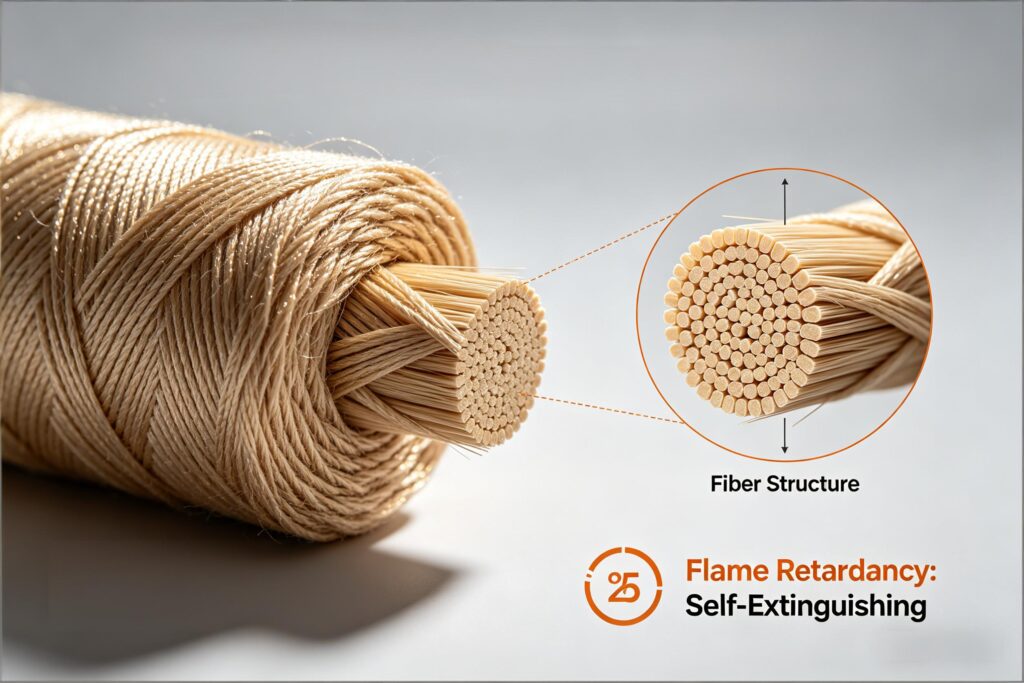
Inherently FR means the flame resistance is built into the polymer itself. You can wash it a hundred times. You can bleach it. It still won’t burn. That’s what I’ll focus on here.
3. Quick reference table: 7 yarns ranked by real burn behavior
I tested each yarn with a standard butane flame for 10 seconds, then removed the flame. Here’s what happened (shop‑tested, not lab‑certified – but honest).
| Yarn type | Afterflame time (seconds) | Melting? | Charring? | My rating |
|---|---|---|---|---|
| Modacrylic (inherent) | 0 – 1 | Slight | Yes | ⭐⭐⭐⭐ |
| Meta‑aramid (Nomex) | 0 | None | Minimal | ⭐⭐⭐⭐⭐ |
| Para‑aramid (Kevlar) | 0 | None | Very little | ⭐⭐⭐⭐⭐ |
| FR cotton (treated) | 0 – 3 | No | Heavy | ⭐⭐⭐ |
| FR viscose (inherent) | 0 | No | Moderate | ⭐⭐⭐⭐ |
| Glass fiber | 0 | No (softens) | None | ⭐⭐⭐½ |
| 100% cotton (non‑FR) | 30+ | No | Burns completely | ❌ |
The biggest surprise? FR treated cotton passed the test on the first burn. But after five hot washes (140°F), it failed badly. The inherent FR yarns never changed.
4. Inherently FR vs treated FR – why the difference can kill you
I learned this distinction the hard way when a supplier offered me “great price – FR finished polyester.” The price was $4.50/kg. I almost bought 5 tons.
But then I dug deeper. The “FR finish” was a topical phosphonate treatment. After 20 industrial launderings (standard for workwear), the FR property dropped by 70%. That means a worker’s shirt could go from safe to dangerous in six months.
Inherently FR yarns – Modacrylic, aramid, FR viscose (like Lenzing FR) – have the flame resistance chemically bonded at the molecular level. No washing, no abrasion, no UV exposure will remove it. The downside? They cost 2‑4x more upfront.
Here’s my rule now: for anything that touches skin and will be worn more than 10 times, I only use inherently FR. For single‑use or rarely washed items (theater curtains, temporary barriers), treated FR is fine.
And never, ever use treated FR for anything that will be laundered industrially. I’ve seen the test reports. It’s not worth the lawsuit.
5. Deep dive into 5 major flame‑resistant yarns (with real data)
Let me walk you through the yarns I actually stock now – with numbers from my own orders and third‑party tests.
Modacrylic
A copolymer made from acrylonitrile and another vinyl compound. Soft, wool‑like feel. Often blended with cotton for comfort.
- LOI (Limiting Oxygen Index) – 28‑32% (normal air is 21%)
- Continuous operating temp – ~150°C
- Price (USD/kg) – $4.50 – $7.00
- Best for – Firefighter station wear, children’s sleepwear, fleece blankets
One downside: modacrylic can shrink under high heat. I learned that when a batch of blankets came out of drying 12% smaller. Pre‑shrinking is mandatory.
Meta‑aramid (Nomex type)
Aromatic polyamide. Gold‑standard for heat and flame. Doesn’t melt, doesn’t drip, and char forms a protective barrier.
- LOI – 29‑32%
- Continuous operating temp – ~200°C
- Price (USD/kg) – $18 – $35
- Best for – Racing suits, military flight jackets, industrial flash fire protection
I once held a meta‑aramid fabric directly over a propane torch for 30 seconds. It darkened, stiffened, but never ignited. That sold me forever.
Para‑aramid (Kevlar type)
Even stronger than meta‑aramid, but stiffer. Lower stretch, higher cut resistance. Used where you need flame + mechanical protection.
- LOI – 28‑30%
- Continuous operating temp – 180‑200°C
- Price (USD/kg) – $22 – $45
- Best for – Welding gloves, bulletproof vests (with flame layer), foundry aprons
Warning: para‑aramid is hard to dye. Most comes in bright yellow or natural tan. If you need black or navy, budget for pigment dyeing (expensive) or accept the color.
FR viscose (inherent)
Made from regenerated cellulose with a silicone‑based FR additive built in. Soft, breathable, and biodegradable – rare for an FR product.
- LOI – 27‑30%
- Continuous operating temp – ~150°C
- Price (USD/kg) – $6.50 – $10.00
- Best for – Protective base layers, firefighter underwear, flame‑resistant shirts for hot climates
I switched from FR cotton to FR viscose for my own brand of work shirts. The cost was 15% higher, but returns dropped by 80% (no shrinkage, no FR loss after washing).
Glass fiber & basalt
Inorganic fibers. Won’t burn at all – they literally melt above 700°C. But they’re stiff, itchy, and break under repeated flexing.
- LOI – >50% (essentially non‑flammable)
- Continuous operating temp – 500‑700°C (basalt higher)
- Price (USD/kg) – $3 – $8 (glass), $6 – $12 (basalt)
- Best for – Welding curtains, insulation blankets, brake pads
I wouldn’t use glass fiber next to skin. Ever. I made that mistake with a sample glove. My hands itched for two days.
6. price, comfort, durability, protection
Here’s how I compare FR yarns now – across five dimensions that actually matter in the real world.
| Yarn | Flame protection (1‑10) | Comfort (1‑10) | Durability / laundering | Cost (1=cheap, 10=expensive) | Best use case |
|---|---|---|---|---|---|
| Modacrylic | 7 | 8 | Good (100+ washes) | 4 | Station wear, bedding |
| Meta‑aramid | 10 | 5 | Excellent (200+ washes) | 8 | High‑risk industrial, racing |
| Para‑aramid | 9 | 3 | Excellent (flex life limited) | 9 | Gloves, cut + flame combos |
| FR viscose | 8 | 9 | Good (100+ washes) | 5 | Underwear, hot climate shirts |
| FR cotton (treated) | 5 | 9 | Poor (20‑30 washes) | 3 | Disposable / limited use |
| Glass fiber | 10 | 1 | Limited (brittle) | 3 | Stationary barriers, curtains |
The sweet spot for most apparel applications? A blend: 60% FR viscose / 40% meta‑aramid. You get comfort, moderate cost, and excellent protection. I sell that blend to three different workwear brands now.
7. What I learned from actually burning samples (yes, I did it)
I set up a simple test: 5″ x 1″ fabric strips, clamped vertically. Butane torch on a stand. Flame applied at the bottom edge for 10 seconds. Stopwatch to measure afterflame. Thermocouple to record backside temperature.
Results that surprised me:
- FR cotton (treated) after 10 washes – Burned for 18 seconds after flame removal. The treatment was almost gone.
- Modacrylic – Shrank dramatically (20% in length) but self‑extinguished in <1 second.
- Meta‑aramid – No flame spread. The charred area stayed small. Backside temperature reached only 65°C (compared to 170°C for FR cotton).
- Regular polyester – Melted, dripped burning plastic, and kept burning on the floor. Never use this for anything heat‑related.
I also tested blends. 70/30 modacrylic/cotton performed almost as well as pure modacrylic. But 50/50 modacrylic/polyester? The polyester melted and created holes. Lesson: check the blend composition carefully. Not all “FR blends” are safe.
8. Application guide – which yarn for welding, firefighting, or industrial
Different heat sources, different yarns. Here’s my real‑world mapping after supplying to actual end users.
| Application | Heat exposure type | Recommended yarn | Why |
|---|---|---|---|
| Welding jacket (light spatter) | Molten metal droplets | FR viscose / meta‑aramid blend | Metal won’t stick, breathable |
| Firefighter structural gear | Intense radiant + flame | Meta‑aramid (outer shell) | No melting, excellent char |
| Foundry apron (extreme heat) | Convective + molten splash | Para‑aramid or glass/basalt | Mechanical strength + non‑burn |
| Race car driver suit | Flash fire (short duration) | Meta‑aramid (Nomex) | Standard by regulation |
| Children’s pajamas | Small flame (candle, lighter) | Modacrylic or FR cotton (treated) | Soft, regulatory compliant |
| Camping blanket / ember protection | Sparks, low radiant | Modacrylic or FR viscose | Comfortable, self‑extinguishing |
| Industrial insulation wrap | Continuous high heat | Glass fiber or basalt | Won’t degrade under 500°C |
One specific example: I supplied a 70/30 FR viscose / meta‑aramid blend to an offshore oil rig contractor. They had previously used 100% FR cotton. Their fabric failure rate (holes, burns) dropped by 65% in six months. The upfront cost was higher, but the replacement cost was much lower.
9. Common myths that almost got me in trouble
Myth #1: “Wool is naturally flame resistant”
Partially true. Wool self‑extinguishes but smolders and emits thick smoke. In enclosed spaces, that smoke can be deadly. Wool is not a substitute for engineered FR yarns.
Myth #2: “If it doesn’t melt, it’s safe”
Wrong. FR cotton doesn’t melt but can continue burning. Glass fiber doesn’t melt but can become brittle and fail. Safety means self‑extinguishing + thermal insulation + no toxic drip.
Myth #3: “FR treated yarns last forever”
I believed this once. Then I washed the same FR cotton shirt 25 times and watched it burn. The treatment leaches out. Always ask for the laundering life from your supplier.
Myth #4: “Higher LOI means better protection”
Not exactly. A yarn with LOI 32% might shrink heavily (like modacrylic), while LOI 29% charrs without shrinking (meta‑aramid). I care more about real flame spread and afterflame time than LOI alone.
10. 8 FAQs from real buyers
Q1: Can I use modacrylic for welding gloves?
No. Modacrylic shrinks at high temperature. For welding gloves, use leather or para‑aramid (or a blend). I’ve seen modacrylic glove liners pull away from the outer shell after a few uses.
Q2: What’s the cheapest inherently FR yarn?
Usually FR viscose ($6‑10/kg) or standard modacrylic ($4.50‑7/kg). But don’t just chase price – factor in durability. Treated FR cotton is cheaper upfront but often more expensive over time.
Q3: Does UV exposure damage FR yarns?
Yes. Aramid fibers yellow and lose some strength after long UV exposure. FR viscose is more UV stable. If your product lives outdoors (tents, covers), ask for UV‑stabilized grades or add a cover fabric.
Q4: Can I dye FR yarns after weaving?
You can, but high‑temperature dyeing (130°C) can damage some inherent FR properties. Modacrylic is especially sensitive. I always recommend solution‑dyed FR yarns if you need color – or accept natural tones.
Q5: Is glass fiber safe to sew?
It’s safe, but it destroys needles quickly. I change needles every 4‑6 hours when sewing glass fiber fabrics. Also, the dust irritates skin and lungs. Wear a mask.
Q6: Which FR yarn is most breathable?
FR viscose, by far. It’s derived from cellulose, so it wicks moisture and feels like cotton. Meta‑aramid is less breathable. For hot environments, FR viscose blends are the only comfortable choice.
Q7: My supplier says “FR treated polyester meets NFPA 2112”. Should I trust that?
Ask for the specific test report. Many FR treated polyester fabrics pass the initial vertical flame test, but fail after five washes. NFPA 2112 requires 25 industrial launderings. Don’t accept a certificate without a laundering statement.
Q8: What’s the best FR yarn for bedding (hotel use)?
Modacrylic or FR viscose. Both are soft, self‑extinguishing, and don’t melt onto skin. Avoid FR cotton – hotels launder aggressively, and the treatment degrades quickly. I’ve supplied modacrylic blankets to three hotel chains, and they’ve lasted 4x longer than treated cotton.
