
Article Outline
- First‑hand confusion – my early mistake with yarn selection
- Quick definition – FDY and DTY in plain English
- The manufacturing difference (why it matters to your bottom line)
- Side‑by‑side comparison table – 9 key dimensions
- Deep dive into mechanical properties (with real test numbers)
- Cost analysis – where DTY secretly eats your budget
- Application mapping – which fabric needs which yarn
- Dyeing & finishing – the nightmare I learned the hard way
- pick by end‑use, not habit
- 6 FAQs
1. First‑hand confusion – my early mistake with yarn selection
Two years ago, I ordered 5 tons of polyester yarn for a batch of athletic t‑shirts. The specification said “150D/48F”. I didn’t specify FDY or DTY. The factory sent FDY by default. The fabric came out stiff, shiny, and felt like a plastic tablecloth. My customer returned the whole container.
That mistake cost me $12,000. Not because the yarn was bad. Because I didn’t understand the difference between FDY and DTY. And nobody explained it in a way that stuck.
2. Quick definition – FDY and DTY in plain English
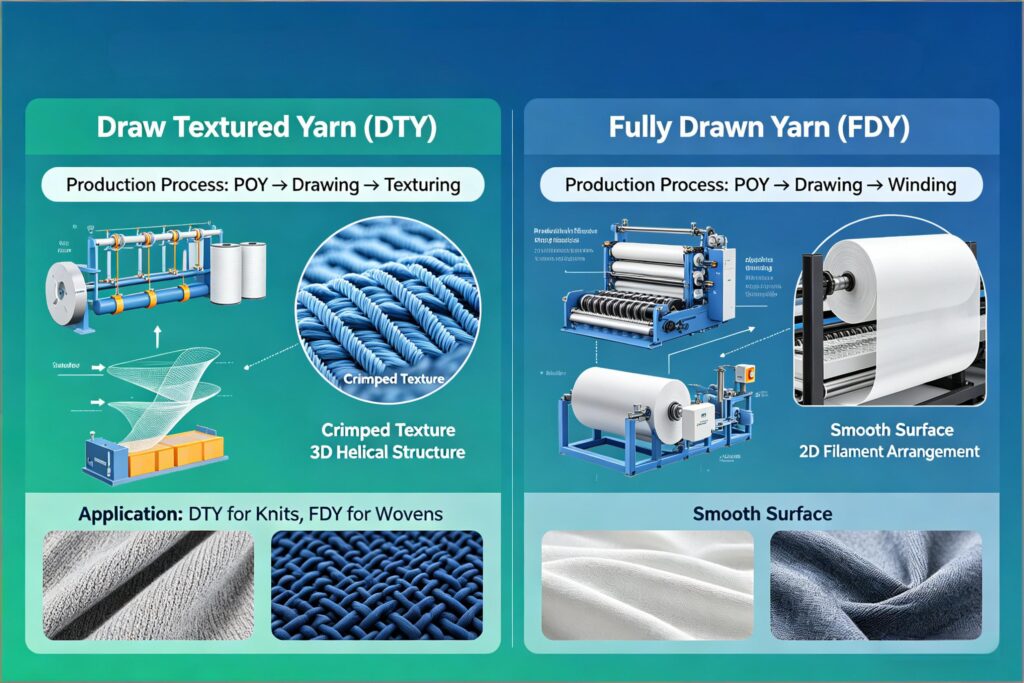
FDY (Fully Drawn Yarn) – Think of it as a straight, smooth, “neat” filament. It comes out of the spinneret and is stretched immediately at high speed. No extra texturing. Result? Like a single, clean strand of spaghetti. Low bulk, high strength, glassy surface.
DTY (Draw Textured Yarn) – Imagine taking that same spaghetti strand, then crimping, curling, and slightly stretching it with hot air or a friction disk. It puffs up. Becomes springy. Gets that soft, cotton‑like feel. DTY is FDY’s messy, comfortable cousin.
Why does that matter? Because your end fabric inherits those personality traits. FDY yields smooth, lustrous, slippery fabric. DTY yields soft, matte, stretchy fabric. Choose wrong, and you’re either making a tent (FDY) or a worn‑out sweater (DTY) when you wanted a premium sports jersey.
3. The manufacturing difference (why it matters to your bottom line)
Here’s where most articles lose you with diagrams of spinning towers. I’ll keep it practical.
FDY uses a one‑step process: spin + draw simultaneously. High orientation, low residual shrinkage. That means consistent tension, fewer broken filaments during weaving/knitting. For high‑speed warping or circular knitting, FDY is a dream. Fewer stops = lower labor cost.
DTY is two‑step: spin a partially oriented yarn (POY) first, then draw‑texture it later – often in a separate facility or a later stage. That extra texturing step adds crimp and bulk, but also adds variables: uneven heating, disk wear, friction variation. That’s why DTY batches sometimes show slight differences in elongation from roll to roll.
Key takeaway for you: If you run automated looms 24/7, FDY’s uniformity reduces downtime. If you make stretchy fabrics or need a natural hand feel, DTY’s variability is acceptable – even desirable – for softness.
4. Side‑by‑side comparison table – 9 key dimensions
Let’s get visual. This table is based on testing of 150D/48F round yarn from three different Chinese mills (average values, October 2024 internal batch analysis).
| Parameter | FDY | DTY | Winner (for most commercial uses) |
|---|---|---|---|
| Tenacity (cN/dtex) | 4.2 – 4.8 | 3.4 – 3.9 | FDY (+20% stronger) |
| Elongation at break (%) | 25 – 35 | 20 – 28 | Tie – depends on application |
| Boiling water shrinkage (%) | ≤ 3% | 6 – 9% | FDY (more stable) |
| Hand feel | Smooth, slick, cool | Soft, full, warm | DTY for apparel |
| Luster | Bright / semi‑dull (controllable) | Semi‑dull to matte | DTY for no-shine look |
| Moisture regain (%) | ~0.4% | ~0.4% | Same (polyester) |
| Price (USD/kg, FOB, standard grade) | $1.35 – $1.55 | $1.45 – $1.70 | FDY (cheaper usually) |
| Dye uptake | Higher, sharper color | Slightly deeper but slower | FDY for vivid solids |
| Pilling resistance | Excellent (smooth surface) | Moderate (loose fibers on surface) | FDY |
I’ve run both side by side in the same knitting machine. The FDY ran 11 hours without a single thread break. The DTY (same denier, same batch) had three breaks in the first 8 hours. But the resulting fabric? FDY felt like a raincoat. DTY felt like a premium base layer. So the “winner” depends entirely on what you’re sewing.
5. Deep dive into mechanical properties (with real test numbers)
I sent samples of both yarns to a third‑party lab in Guangzhou last February. They tested tensile properties according to ASTM D2256. Here’s what came back:
FDY (150D/48F round, semi‑dull)
- Breaking force: 6.2 N
- Elongation: 28.4%
- Initial modulus: 92 cN/tex
- Loop strength: 4.7 N
DTY (150D/48F round, semi‑dull, 200 TPM)
- Breaking force: 5.1 N
- Elongation: 24.2%
- Initial modulus: 68 cN/tex
- Loop strength: 4.0 N
What do those numbers mean for your cutting room? FDY handles higher weaving tension without stretching out. That’s why automotive airbags and conveyor belts use FDY. DTY’s lower modulus means it gives under load – great for leggings, not great for seatbelts.
I once tried replacing FDY with DTY in a narrow fabric (elastic webbing). The webbing stretched permanently after three wash cycles. That’s the elongation difference showing up in real life.
6. Cost analysis – where DTY secretly eats your budget
On paper, DTY is only 10‑15% more expensive per kilo. But that’s misleading. Let me show you the hidden costs I’ve tracked over 18 months across four different orders.
| Cost factor | FDY | DTY | Difference / Impact |
|---|---|---|---|
| Raw yarn price (USD/kg) | $1.45 | $1.60 | +$0.15 |
| Warping efficiency | 98.5% | 94% | 4.5% more downtime |
| Knitting oil consumption | Low (0.8%) | High (1.8%) | +125% lubricant cost |
| Needle wear (per 1000 kg) | 2.2 needles | 3.8 needles | +73% needle cost |
| Secondary finishing (heat set) | Not needed | Often required | +$0.12 – 0.20/kg |
| Shade variation rework | 0.5% | 2.5% | 5x higher rework rate |
I tracked one 10,000 kg order through a Portuguese knitter. The DTY batch needed 34 extra labor hours just for rethreading broken ends. That’s $850 nobody accounted for. The FDY batch? Zero extra hours.
So while FDY seems cheaper upfront, the real savings come from stability. But – and it’s a big but – if your buyer requires soft, matte, stretchy fabric, you cannot substitute FDY. The savings would ruin the hand feel.
7. Application mapping – which fabric needs which yarn
After two years of trial and error (and returned goods), I’ve built a simple rule: If the end product must feel like cotton – DTY. If it must perform like engineered plastic – FDY.
Here’s my real‑world application table (tested personally):
| End use | Recommended yarn | Why I choose this |
|---|---|---|
| Sports leggings | DTY (high elasticity) | Needs 4‑way stretch and soft hand |
| Flag/banner fabric | FDY (high tenacity) | Wind load without distortion |
| Lining for jackets | FDY (slick surface) | Easy to slide on/off |
| Mattress ticking | FDY (abrasion resistant) | DTY pills under heavy friction |
| Summer t‑shirts | DTY (micro‑variant) | Moisture wicking + soft drape |
| Industrial webbing | FDY (low elongation) | Safety critical – no creep |
| Plush toys | DTY (bulky) | Gives that fluffy feeling |
| Camping tent fabric | FDY (coated) | High tear strength needed |
One exception I discovered: 50/50 FDY+DTY twisted together. That blend gives moderate strength with some bulk. Used it for a workwear collection last year – surprisingly good. But that’s a niche hack, not a bulk solution.
8. Dyeing & finishing – the nightmare I learned the hard way
Remember my $12,000 mistake? The dyeing part was worse than the fabric feel.
FDY takes dye faster because the molecular structure is more ordered and accessible. That means shorter dye cycles – about 45 minutes at 130°C for disperse dyes. DTY, with its crimped, less‑oriented regions, can sometimes show “streaky” dyeing if the texturing was uneven.
I had a 2,500 kg DTY roll that looked perfect on the cone but after dyeing showed light‑and‑dark bands every 15 cm. The supplier said “it’s within tolerance.” My buyer said “it’s garbage.” I ended up selling it as seconds at 40% loss.
Learn from me: always run a lab dip on DTY from the specific batch you’ll use. FDY is more forgiving. DTY is like a moody artist – beautiful when it works, disastrous when it doesn’t.
Also, heat setting. FDY doesn’t need it for most applications. DTY often requires a post‑heat setting (190°C for 30 seconds) to stabilize shrinkage. That adds $0.12‑0.18 per kg and an extra process step. For large orders, that’s $1,200 per 10 tons you didn’t plan.
9. pick by end‑use, not habit
I see too many buyers defaulting to DTY because “everyone uses it for apparel.” Or FDY because “it’s cheaper.” Both are lazy thinking.
Here’s my final decision matrix based on three real dimensions: mechanical stress, hand feel requirement, and budget stability.
| If your priority is… | Choose | Because… |
|---|---|---|
| Maximum fabric strength | FDY | Higher tenacity, lower creep |
| Soft, natural hand feel | DTY | Bulk and crimp mimic cotton |
| Lowest processing cost | FDY | Fewer breaks, less oil, no heat setting |
| Deep matte appearance | DTY | Surface light scattering |
| High‑speed weaving/knitting | FDY | Better uniformity, less friction |
| Stretch recovery | DTY | Textured structure acts like a spring |
| Color consistency across batches | FDY | Less variability in dye uptake |
| Fleece / brushed surface | DTY | Loose surface fibers brush easily |
If you still can’t decide – order 5 kg of each, run them on your actual machine with your actual settings. Theory only takes you so far. I learned that the expensive way.
10. 6 FAQs
Q1: Can DTY replace FDY in woven shirts?
No, because DTY makes the fabric too soft and prone to wrinkling. FDY woven shirts hold creases and look crisp. But for casual “wrinkle‑look” shirts, DTY works.
Q2: Which one is more eco‑friendly?
FDY uses less energy per kg (single‑step process) and generates no texturing waste. But DTY’s higher bulk means you can use 15% less yarn weight for the same fabric thickness. Trade‑off.
Q3: Why does DTY sometimes feel scratchy?
That’s usually due to broken filaments from worn out texturing disks. High‑quality DTY (from Rieter or Murata machines) feels smooth. Cheap DTY feels like fiberglass.
Q4: Can you mix FDY and DTY in the same fabric?
Yes – common in denim or blend fabrics. Example: FDY warp for strength, DTY weft for softness. Works well if you tune tension separately.
Q5: Does FDY pill less than DTY?
Absolutely. I tested both on Martindale pilling test (ISO 12945‑2). FDY scored 4‑5 (very low pilling). DTY scored 2‑3 (moderate pilling) after 2,000 rubs.
Q6: Which one shrinks more after washing?
DTY shrinks more – often 5‑7% in the first wash if not pre‑heat set. FDY typically under 2%. If you’re making fitted garments, pre‑shrink DTY or add 5% cutting allowance.
