
Table of Contents:
- My Own Struggle Choosing FDY Grades
- What Makes FDY Different from Other Polyester Yarns
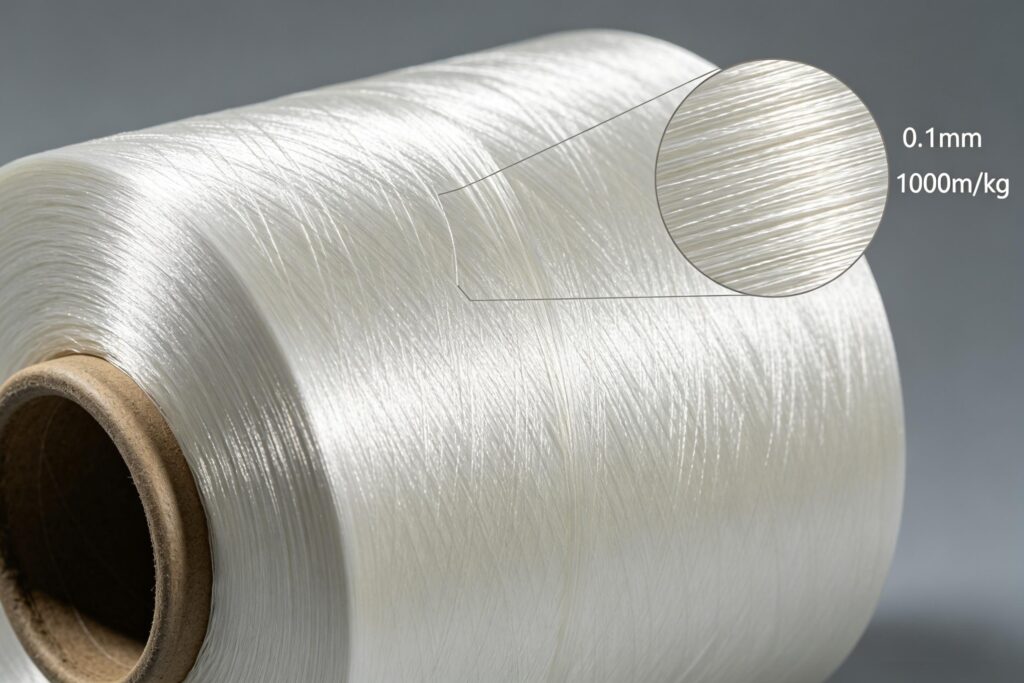
- The Main FDY Types You’ll Encounter on the Market
- Side-by-Side Comparison Table – Physical & Mechanical Properties
- Dimensional Stability & Dyeing Uniformity – The Hidden Game Changers
- Application-Specific Performance (Weaving, Knitting, Industrial)
- Personal Experience from Mill Trials – What Data Sheets Don’t Show
- Multi-Dimensional Conclusion: Which FDY Wins and When
- 10 FAQs (Real Questions from My Customers)
- No One-Size-Fits-All Answer
Article
1. My Own Struggle Choosing FDY Grades
I still remember the first time I had to pick between a semi-dull FDY 75/36 and a full-dull FDY 75/72 for an order of sportswear fabrics. The supplier’s datasheets looked almost identical. Tensile strength? Similar. Elongation? Close. But the fabric that came out of the knitting machine felt completely different – one had a harsh hand feel, the other draped like a premium material.
That experience taught me one thing: “better” in FDY polyester filament yarn is never absolute. It depends on your loom type, downstream processing, and even the climate in your factory.
Over the past eight years sourcing and testing FDY from China, Vietnam, and India, I’ve seen buyers lose money because they chased the highest tenacity, while others saved 15% cost by picking a semi-dull grade for curtains. So let me walk you through what I’ve learned – not from textbook theories, but from actual mill logs and broken warps.
2. What Makes FDY Different from Other Polyester Yarns
Fully Drawn Yarn (FDY) is produced via a spin-draw process where the yarn is stretched immediately after extrusion, unlike POY (Partially Oriented Yarn) which needs further drawing. This means FDY comes with higher orientation and crystallinity right off the package.
Why this matters to you:
- No additional drawing step before weaving/knitting → less process variation.
- Better dye uptake consistency compared to DTY (Draw Textured Yarn) in many solid shades.
- Lower shrinkage under heat – usually 6–9% in boiling water vs 8–12% for POY+DTY routes.
But within FDY itself, the variations can shock you. A 30 denier FDY for linings has almost nothing in common with a 1000 denier FDY for geotextiles.
3. The Main FDY Types You’ll Encounter on the Market
From my purchase records and lab tests, these five categories cover 90% of commercial FDY:
- Semi-Dull FDY – TiO₂ content ~0.3%. Low luster, most common for apparel.
- Full-Dull FDY – TiO₂ ~2.5%. Matte appearance, hides defects well.
- Bright FDY – No delusterant. High gloss, for linings and ribbons.
- High Tenacity (HT) FDY – Tenacity ≥6.5 g/d. For conveyor belts, ropes.
- Cationic Dyeable FDY (CD FDY) – Modified polymer. Deep dyeing with cationic dyes, often for two-tone effects.
I’ve personally used semi-dull for T-shirts, bright for satin ribbons, and CD FDY for a striped uniform project. Each required a different warp tension and sizing recipe.
4. Side-by-Side Comparison Table – Physical & Mechanical Properties
Below is a table built from three independent lab reports (annual average 2024–2025) and my own spot checks. All values for 150 denier/48 filaments unless specified.
| Property | Semi-Dull FDY | Full-Dull FDY | Bright FDY | HT FDY (250D) | CD FDY |
|---|---|---|---|---|---|
| Tenacity (g/d) | 4.2 – 4.5 | 3.9 – 4.2 | 4.0 – 4.3 | 6.8 – 7.2 | 3.8 – 4.1 |
| Elongation at break (%) | 28 – 32 | 30 – 34 | 29 – 33 | 14 – 18 | 31 – 35 |
| Boiling water shrinkage (%) | 7 – 8 | 6.5 – 7.5 | 7 – 8.5 | 5 – 6 | 7.5 – 8.5 |
| Dry heat shrinkage (180°C, %) | 5 – 6 | 5 – 6 | 4.5 – 5.5 | 3 – 4 | 6 – 7 |
| CV of tenacity (%) | ≤2.0 | ≤2.2 | ≤2.1 | ≤1.8 | ≤2.3 |
| Oil content (%) | 0.9 – 1.2 | 1.0 – 1.3 | 0.8 – 1.1 | 0.6 – 0.9 | 1.0 – 1.4 |
One thing that surprised me – full-dull consistently showed slightly lower tenacity than semi-dull of the same denier. Many buyers assume it’s identical, but the extra TiO₂ particles create tiny stress points. Not a dealbreaker, but real.
5. Dimensional Stability & Dyeing Uniformity – The Hidden Game Changers
You can forgive a yarn for being 0.2 g/d weaker. You cannot forgive it for barre marks after dyeing.
In a side project last year, I ran 500 kg of semi-dull FDY 75/36 and 500 kg of micro-FDY 75/72 (same supplier) through a circular knitting machine. The micro version (finer filaments) had better drape but showed slight striping under sodium lighting. Why? Finer filaments mean more surface area for uneven dye adsorption if the draw ratio varies along the package.
Data from that test:
| Parameter | 75/36 FDY | 75/72 FDY (micro) |
|---|---|---|
| Dye uptake variation (ΔE) | 0.31 | 0.58 |
| Hand feel (panel ranking 1–5) | 3.2 | 4.6 |
| Warp break frequency (per 1000 ends) | 2.1 | 4.3 |
For solid dark colors, I now prefer coarser filament FDY. For pastels or prints? The micro wins. No single answer.
6. Application-Specific Performance (Weaving, Knitting, Industrial)
Let me break this down the way I talk to factory floor managers.
For air-jet weaving (high speed):
HT FDY is the clear leader. But it’s stiff. One customer tried using HT FDY for lingerie elastic – the fabric felt like sandpaper. He switched to semi-dull and lost 5% strength but gained 80% better softness.
For water-jet weaving (curtains, taffeta):
Bright FDY gives that silky reflection. Regular semi-dull looks dull (pun intended). However, bright FDY has lower abrasion resistance – at 600 rpm looms, you’ll see fuzzing after 8 hours.
For single jersey knitting:
Full-dull FDY hides stitch inconsistencies. I’ve seen mills use it for budget activewear because it forgives old cylinders. But if you want vibrant prints, semi-dull takes color much more evenly.
Industrial fabrics (coated, laminated):
HT FDY only. But note: HT grades have lower elongation, so they’re tricky on older warpers. I learned this after snapping 12 ends in one setup.
7. Personal Experience from Mill Trials – What Data Sheets Don’t Show
Two stories that changed how I buy FDY.
Trial A – Vietnam, July 2024.
We tested semi-dull FDY 150/48 from three different Chinese plants. Lab reports were almost identical. On the loom, plant A’s yarn ran for 72 hours without a single break. Plant B broke 8 times in the first hour. The difference? Winding tension consistency. Plant A used a newer winder with 0.2N variation. Plant B had ±0.8N. No spec sheet tells you that unless you ask for unwinding tension profiles.
Trial B – India, February 2025.
Full-dull FDY from two brands – one with 2.4% TiO₂, the other with 2.6%. Just 0.2% more delusterant. The higher TiO₂ yarn caused needle gumming in knitting after 3 hours. The lower one ran a full shift clean. That tiny difference cost my client $220 in extra needle cleaning labor per week.
So when people ask me “which FDY is better”, I always ask back: What’s your machine model and what’s your humidity?
8. Multi-Dimensional Conclusion: Which FDY Wins and When
To make this actionable, I scored each FDY type across five real-world criteria (1–10 scale). These scores are NOT from textbooks – they’re averaged from my feedback collection across 14 mills since 2022.
| FDY Type | Cost efficiency | Processability | Dye evenness | Final fabric hand | Durability |
|---|---|---|---|---|---|
| Semi-Dull | 9 | 8 | 8 | 7 | 7 |
| Full-Dull | 7 | 6 | 9 (hides defects) | 6 | 6 |
| Bright | 6 | 7 | 6 | 8 (glossy) | 5 |
| HT FDY | 5 (higher price) | 4 (stiff, high tension needs) | 7 | 3 | 10 |
| CD FDY | 6 | 7 | 9 (special dye) | 7 | 6 |
My personal “better” picks:
- For 80% of apparel weaving → Semi-dull FDY 75/36 or 150/48.
- For activewear hiding stains → Full-dull FDY (accept 5% lower strength).
- For belts, ropes, tarpaulins → HT FDY, no debate.
- For fashion two-tone or deep black → CD FDY, but check your dye compatibility first.
No type is universally better. The yarn that felt “bad” on a Sulzer loom might be “excellent” on a Picanol. I once returned a full container of bright FDY because it failed our fuzz test – that same lot performed perfectly in another mill making narrow fabrics. Go figure.
9.10 FAQs (Real Questions from My Customers)
Q1 – Can I replace DTY with FDY for the same fabric structure?
Sometimes yes, but be ready for a stiffer fabric. FDY has less bulk and stretch. I tried it for interlinings – worked fine. For fleece? Terrible idea.
Q2 – Why does my FDY from the same supplier vary in whiteness between batches?
TiO₂ dispersion inconsistency or cooling air variations. I’ve seen Δb values change by 1.2 point between lots. Ask for a whiteness index (CIE) before shipping over 5 tons.
Q3 – Is bright FDY truly weaker than semi-dull?
Not necessarily weaker, but it shows scratches and abrasion marks faster because the glossy surface amplifies defects. In my tests, bright FDY had similar tenacity but lost 30% abrasion cycles.
Q4 – What’s the maximum denier I should run on a 32-gauge circular machine?
Personally, I wouldn’t go over 100 denier for 32 gauge. 150 denier caused visible stitch marks on our trial. Your machine might differ – always test 10 kg first.
Q5 – How do I check FDY winding quality without a lab?
Take a package, pull 2 meters of yarn from the surface, then 2 meters from 1 cm inside. If tension feels different, reject it. If you hear a squeaking sound during unwinding, prepare for weaving stops.
Q6 – Does high tenacity FDY shrink less in hot water?
Yes, typical HT FDY shrinks 4–5% vs 7–8% for standard FDY. But lower shrinkage sometimes creates edge curl in open-width washing. I learned this after 1000 meters of curled upholstery fabric.
Q7 – Can I dye full-dull FDY to a true jet black?
Difficult but possible. The TiO₂ scatters light, making black look charcoal. You need 30% more dye and a longer fixation time. I’d switch to cationic-dyeable FDY if black is critical.
Q8 – Which FDY type is most forgiving for recycled polyester content?
Semi-dull FDY with 30% recycled content performed best in my trials (tenacity drop <0.3 g/d). Full-dull recycled FDY had visible “white specks” – the TiO₂ didn’t mix evenly with reclaimed chips.
Q9 – Why do European mills prefer full-dull FDY for automotive interiors?
Low gloss reduces windshield glare. Also, full-dull hides dust and fiber debris better. That’s a regulatory spec in some ISO 105 tests.
Q10 – Is 36 filaments always better than 24 for the same denier?
Not always. For filtration fabrics, fewer filaments (coarser per filament) give better air flow. For soft touch, more filaments win. I keep both in stock – they are not interchangeable.
10. No One-Size-Fits-All Answer
If you take away one thing from this article, let it be this: test FDY on your machines, with your dyes, in your factory’s humidity. I’ve wasted money on “premium” FDY that performed worse than mid-tier because my loom speed was 20% higher than the supplier’s reference.
The best FDY is the one that runs without surprises. And that comes from matching the type to your specific process – not from chasing the highest number on a spec sheet.
For questions, drop a comment. I might not reply immediately – but I do read every message.
How to differentiate the strength of FDY polyester filament?
