
Table of Contents
- My Embarrassing Mistake With Yarn Types as a Beginner
- The Simple Breakdown – How Yarn Is Categorized
- Natural Yarns – The Classics (Wool, Cotton, Linen, Silk)
- Synthetic Yarns – The Workhorses (Polyester, Nylon, Acrylic, Polypropylene)
- Blended Yarns – The Best of Both Worlds
- Specialty Yarns – For When Normal Isn’t Enough
- Yarn by Structure – Single, Ply, Cabled, Textured
- 10 Common Yarn Types Side-by-Side
- Which Yarn Type to Choose for Your Product
- My Personal Recommendations After 8 Years in the Industry
- FAQs – 9 Questions Buyers Always Ask
1. My Embarrassing Mistake With Yarn Types as a Beginner
I still cringe thinking about this.
Early in my career, a customer asked for “a soft, warm yarn for baby blankets.” I confidently recommended acrylic. It’s soft, right? It’s warm, right? And it’s cheap.
The customer made 5,000 blankets. They sold well for about three months.
Then the complaints started. “Pilling everywhere.” “Feels scratchy after washing.” “Not breathable – my baby sweated in it.”
I felt terrible. I cost that customer real money and real reputation.
That’s when I learned: you can’t just pick a yarn type based on one characteristic. You have to understand the trade-offs. Softness vs. durability. Warmth vs. breathability. Cost vs. performance.
Since then, I’ve worked with dozens of yarn types across clothing, carpets, toys, and industrial applications. I’ve made good choices. I’ve made bad ones. And I’ve kept notes on all of them.
2. The Simple Breakdown – How Yarn Is Categorized
Before we dive into specific types, let me give you a simple framework.
Yarn types are categorized in three main ways:
- By fiber origin – Natural (from plants or animals) vs. Synthetic (man-made) vs. Blended (mix of both)
- By structure – Single yarn, plied yarn, cabled yarn, textured yarn
- By function – Standard vs. specialty (flame-resistant, moisture-wicking, etc.)
I’ll walk you through each category. But honestly, the fiber origin is where most of the important differences live. That’s what I focus on first.
Let me start with natural yarns.
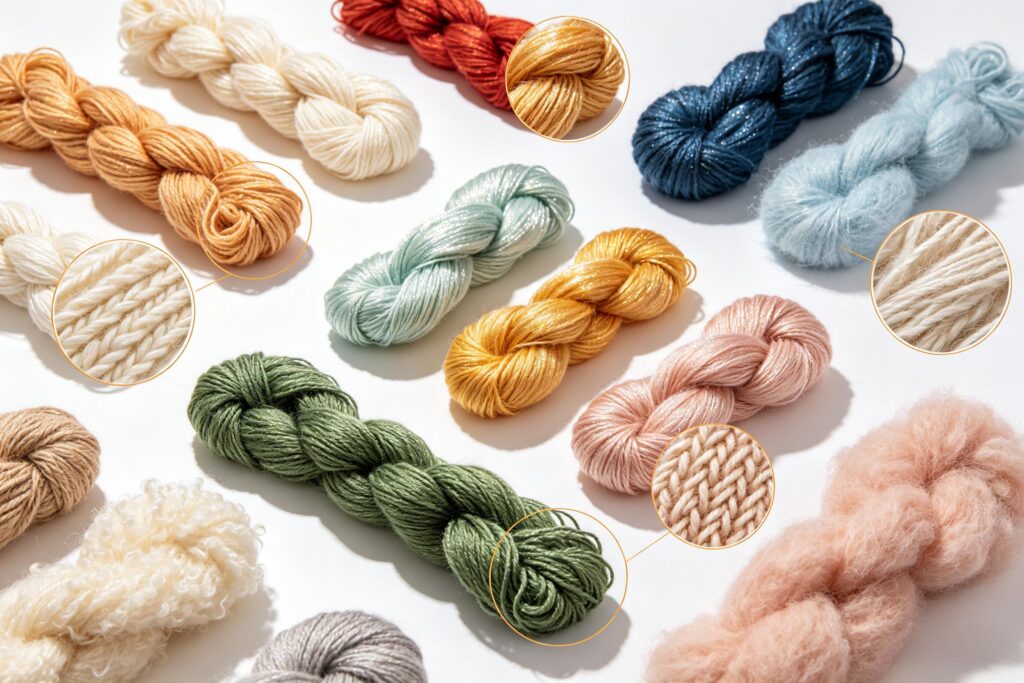
3. Natural Yarns – The Classics (Wool, Cotton, Linen, Silk)
Natural yarns have been around for thousands of years. There’s a reason we still use them.
Cotton Yarn
Cotton is the most common natural yarn on the planet. About 25% of global fiber production is cotton.
What I like about it:
- Breathable – air moves through it easily. Great for summer clothing.
- Soft – gets even softer with washing.
- Absorbent – can hold up to 25% of its weight in water.
- Easy to dye – takes color beautifully.
What frustrates me about it:
- Shrinks – especially the first wash. Can lose 5–10%.
- Wrinkles easily – looks messy fast.
- Not very warm – bad for cold weather.
- Heavy – for the same warmth, cotton is much heavier than wool or polyester.
Best for: T-shirts, summer dresses, underwear, baby clothes, dish towels.
Worst for: Winter jackets, outdoor gear, anything that needs to dry fast.
Wool Yarn
Wool is nature’s performance fiber. Sheep (and goats, alpacas, rabbits) figured it out long before humans did.
What I like about it:
- Warm even when wet – this is huge. Cotton loses 90% of its insulation when wet. Wool retains most of it.
- Naturally flame-resistant – self-extinguishing.
- Odor-resistant – doesn’t trap smells like synthetics do.
- Elastic – stretches and bounces back.
What frustrates me about it:
- Can be scratchy – depends on the micron count. Fine merino is soft. Standard wool can itch.
- Expensive – good wool costs 3–5x more than cotton or acrylic.
- Requires care – can felt/shrink if washed wrong.
- Not all sheep are equal – merino, cashmere, and alpaca are totally different beasts.
Best for: Sweaters, socks, base layers, blankets, carpets (wool carpet is premium).
Worst for: Vegan products (obviously), budget lines, hot climates.
Linen Yarn
Linen comes from flax plants. It’s been used for millennia.
What I like about it:
- Incredibly breathable – feels cool against skin.
- Gets softer over time – unlike most yarns that degrade, linen improves with washing.
- Strong – one of the strongest natural fibers.
- Eco-friendly – flax grows with little water or pesticides.
What frustrates me about it:
- Wrinkles like crazy – some people call it “character.” Others call it annoying.
- Stiff at first – takes several washes to soften.
- Expensive – limited production.
- Low elasticity – doesn’t stretch. Bags out over time.
Best for: Summer shirts, dresses, tablecloths, high-end bedding.
Worst for: Socks, activewear, anything that needs stretch.
Silk Yarn
Silk is the luxury yarn. Beautiful, expensive, and a pain to work with.
What I like about it:
- Unbelievably smooth – lowest friction of any natural fiber.
- Temperature regulating – keeps you cool in summer, warm in winter.
- Strong for its weight – silk is surprisingly tough.
- Takes dye incredibly well – colors are vibrant and deep.
What frustrates me about it:
- Expensive – often $50–100 per pound.
- Delicate – weak when wet, degrades in sunlight.
- Difficult to care for – dry clean or hand wash only.
- Ethical concerns – traditional silk production kills silkworms (vegan alternatives exist but are rare).
Best for: Luxury scarves, ties, lingerie, high-end blouses.
Worst for: Everyday clothing, kid’s items, budget products.
4. Synthetic Yarns – The Workhorses (Polyester, Nylon, Acrylic, Polypropylene)
Synthetics changed everything. They’re cheaper, stronger in some ways, and available in endless varieties.
Polyester Yarn
Polyester is the king of synthetics. About 55% of global fiber production is polyester.
What I like about it:
- Durable – resists abrasion, stretching, and shrinking.
- Quick-drying – dries much faster than cotton or wool.
- Wrinkle-resistant – looks neat without ironing.
- Cheap – significantly lower cost than natural alternatives.
- Recycled options available – rPET is getting better every year.
What frustrates me about it:
- Not breathable – can feel clammy in hot weather.
- Static buildup – especially in dry climates.
- Pilling – low-quality polyester pills badly.
- Melts – can’t iron or dry on high heat.
- Microplastics – sheds plastic fibers when washed.
Best for: Hoodies, sportswear, fleece blankets, carpets, stuffed toys, outdoor gear.
Worst for: Luxury products, extremely breathable clothing, eco-conscious premium brands (though recycled helps).
Nylon Yarn
Nylon is the toughness specialist. It was originally developed as a synthetic replacement for silk.
What I like about it:
- Extremely strong – stronger than polyester by weight.
- Excellent elasticity – stretches and recovers well.
- Abrasion-resistant – ideal for high-friction applications.
- Lightweight – feels lighter than polyester.
What frustrates me about it:
- Poor UV resistance – degrades in sunlight.
- Absorbs moisture more than polyester (can feel damp).
- More expensive than polyester.
- Static and pilling can still be issues.
Best for: Socks, activewear, hosiery, ropes, outdoor gear (with UV protection), carpet (especially high-traffic).
Worst for: Products exposed to constant sunlight without treatment.
Acrylic Yarn
Acrylic is often called “fake wool.” It looks and feels similar but costs much less.
What I like about it:
- Soft – very similar hand-feel to wool.
- Warm – good insulation.
- Lightweight – lighter than wool for same warmth.
- Affordable – significantly cheaper than wool.
- Resists moths and mildew – unlike wool.
What frustrates me about it:
- Pills badly – this is the biggest complaint.
- Less breathable than wool.
- Can feel “plasticky” to some people.
- Not as durable as polyester or nylon.
- Lower melting point – heat sensitivity.
Best for: Budget sweaters, blankets, scarves, hats, stuffed toys, baby blankets (if high-quality).
Worst for: High-end fashion, products that need durability, anything that requires natural breathability.
Polypropylene Yarn
Polypropylene is the moisture manager. It doesn’t absorb water at all.
What I like about it:
- Zero moisture absorption – literally doesn’t get wet.
- Floats – lower density than water.
- Chemical resistant – doesn’t react with acids or alkalis.
- Cheap – one of the most affordable synthetics.
- Lightest common yarn – floats on water.
What frustrates me about it:
- Low melting point – can’t be ironed or dried hot.
- Poor UV resistance – degrades quickly in sunlight.
- Hard to dye – most polypropylene is solution-dyed (color added before spinning).
- Feels waxy – not soft like polyester or acrylic.
Best for: Ropes, geotextiles, outdoor furniture fabrics, carpet backing, performance base layers (moisture-wicking).
Worst for: Clothing against sensitive skin, products exposed to sun without UV protection.
5. Blended Yarns – The Best of Both Worlds
Blends combine different fibers to get better properties. This is where things get smart.
The most common blends:
| Blend | Typical Ratio | Why It Works |
|---|---|---|
| Polyester-Cotton (PC) | 65/35 or 50/50 | Breathability of cotton + durability of polyester. Less shrinking, fewer wrinkles. |
| Cotton-Polyester (CVC) | 60/40 cotton/poly | More cotton feel, still gets some durability. |
| Wool-Acrylic | 30/70 or 50/50 | Lower cost than pure wool, still warm, less pilling than pure acrylic. |
| Nylon-Wool | 20/80 | Adds strength to wool for socks. Lasts much longer than pure wool. |
| Polyester-Spandex | 90/10 | Adds stretch. Essential for activewear. |
| Cotton-Spandex | 95/5 | Comfortable stretch for casual wear. |
My personal take on blends:
For everyday clothing, I love polyester-cotton blends. They wrinkle less than pure cotton, breathe better than pure polyester, and cost less than either premium option.
For socks, nylon-wool is unbeatable. Pure wool socks wear through in months. Add 20% nylon and they last years.
Don’t automatically assume pure is better. Blends solve real problems.
6. Specialty Yarns – For When Normal Isn’t Enough
These aren’t for everyone. But when you need them, nothing else works.
Flame-Resistant Yarns
Made from modacrylic, aramid (Nomex, Kevlar), or FR-treated polyester.
Used for: Firefighter gear, welding aprons, industrial uniforms, children’s sleepwear (by law in many countries).
Trade-off: Expensive, harder to process, limited color options.
Antimicrobial Yarns
Treated with silver ions or other antimicrobial agents. Reduces odor and bacterial growth.
Used for: Socks, activewear, hospital linens, underwear.
Trade-off: Effect washes out over time (50+ washes typically). Costs 20–40% more.
Moisture-Wicking Yarns
Engineered with special cross-sections that pull sweat away from skin.
Used for: Performance athletic wear, base layers.
Trade-off: Usually only available in synthetics (polyester, nylon). Feels different from standard yarns.
Low-Melt Yarns
Polyester or polyamide that melts at lower temperatures. Used to bond other yarns together.
Used for: Shoe uppers, automotive interiors, carpet backing, technical textiles.
Trade-off: Not useful for normal fabrics. Requires special equipment.
7. Yarn by Structure – Single, Ply, Cabled, Textured
Fiber type isn’t everything. How the yarn is constructed matters just as much.
| Structure | What It Is | Strength | Softness | Best For |
|---|---|---|---|---|
| Single yarn | One twisted strand | Lower | Higher | Socks, lightweight knits |
| 2-ply | Two singles twisted together | Higher | Medium | Sweaters, scarves, durability needed |
| 3-ply or more | Three+ singles twisted | Highest | Lower | Heavy-duty, carpets, ropes |
| Cabled | Plied yarns twisted together | Very high | Lower | Industrial, marine ropes |
| Textured | Crimped/bulked (like polyester DTY) | Medium | High | Fleece, sweaters, blankets |
| High-tenacity | Drawn for strength | Highest | Low | Industrial, straps, geotextiles |
Here’s what I’ve learned: for most clothing, 2-ply gives you the best balance of durability and softness. Single yarns pill faster. 3-ply is often overkill for apparel.
For carpets, cabled yarns are standard – they hold twist and resist matting.
8. 10 Common Yarn Types Side-by-Side
| Yarn Type | Softness (1–5) | Durability (1–5) | Warmth (1–5) | Breathability (1–5) | Cost (1=Low, 5=High) | Best Use |
|---|---|---|---|---|---|---|
| Cotton | 4 | 3 | 1 | 5 | 2 | T-shirts, summer wear, baby products |
| Wool (merino) | 4.5 | 3.5 | 5 | 3.5 | 4 | Sweaters, base layers, socks |
| Linen | 2 (gets better) | 4 | 1 | 5 | 3.5 | Summer shirts, table linens |
| Silk | 5 | 3 | 2.5 | 4 | 5 | Luxury scarves, lingerie |
| Polyester | 2–4 (varies) | 4.5 | 3.5 | 1.5 | 1.5 | Hoodies, fleece, carpets, toys |
| Nylon | 2.5 | 5 | 2 | 1.5 | 2.5 | Socks, activewear, ropes |
| Acrylic | 3.5 | 2.5 | 4 | 1.5 | 1.5 | Budget sweaters, blankets, toys |
| Polypropylene | 1.5 | 3.5 | 1 | 1 | 1.5 | Ropes, outdoor fabrics, backing |
| Poly-Cotton (65/35) | 3.5 | 3.5 | 2 | 3 | 2 | Everyday shirts, uniforms, workwear |
| Nylon-Wool (20/80) | 4 | 4 | 4.5 | 3 | 3.5 | Performance socks, durable sweaters |
Key takeaways from the table:
- Softest – Silk, merino wool, high-quality cotton
- Most durable – Nylon, polyester, linen
- Warmest – Wool, acrylic, wool-nylon blends
- Most breathable – Cotton, linen, silk
- Best value – Polyester (performance per dollar) or poly-cotton (balance)
No single yarn wins everything. That’s why understanding trade-offs is so important.
9. Which Yarn Type to Choose for Your Product
Let me make this practical for what you actually make.
For clothing manufacturers (hoodies, T-shirts, socks, sweaters):
| Product | My Recommendation | Why |
|---|---|---|
| Basic T-shirts | Cotton or poly-cotton (65/35) | Breathable + durable + cheap |
| Hoodies & sweatshirts | Polyester fleece or cotton-poly blend | Warm, soft, holds shape |
| Socks | Nylon-wool (20/80) or cotton-nylon | Durability where it matters |
| Sweaters (budget) | Acrylic or acrylic-wool blend | Cheap, warm, looks decent |
| Sweaters (premium) | Merino wool | Worth the cost for quality buyers |
| Activewear | Polyester-spandex (90/10) | Stretch, moisture-wicking, durable |
For carpet & rug producers:
| Carpet Type | Yarn Recommendation | Why |
|---|---|---|
| Budget residential | Polypropylene or polyester | Cheap, stain-resistant |
| Mid-range residential | Polyester (BCF) | Soft, good color retention |
| Premium residential | Wool or wool-nylon | Durable, luxurious, natural |
| High-traffic commercial | Nylon | Best abrasion resistance |
For stuffed toy & plush manufacturers:
| Toy Type | Yarn Recommendation | Why |
|---|---|---|
| Budget toys | Acrylic | Cheap, soft enough for kids |
| Mid-range toys | Polyester (hollow fiber) | Washable, holds shape |
| Premium / export toys | Polyester or acrylic (better quality) | Consistent, safe, pilling-resistant |
For industrial & technical applications:
| Application | Yarn Recommendation | Why |
|---|---|---|
| Ropes & cords | Polypropylene or nylon | Lightweight or strong |
| Geotextiles | Polypropylene | Chemical resistance, cheap |
| Conveyor belts | Polyester (high-tenacity) | Low stretch, strong |
| Fire-resistant | Modacrylic or aramid | Self-extinguishing |
10. My Personal Recommendations After 8 Years in the Industry
After all the testing, all the mistakes, and all the samples, here’s what I actually use.
For everyday apparel (T-shirts, casual shirts):
Poly-cotton blend (65/35 or 50/50). It’s not the softest or the most breathable. But it’s the most practical. Less ironing. Less shrinking. Better price.
For hoodies and sweaters (mid-range):
Polyester fleece or acrylic-wool blend. Pure cotton fleece is heavy and shrinks. Pure acrylic pills. The blends work better.
For socks:
Nylon-wool for winter. Cotton-nylon for summer. Never 100% of anything except maybe merino if you have money to burn.
For carpets (my own home, not just clients):
Polyester in bedrooms (soft). Nylon in hallways and stairs (tough). Wool if I find a deal (but rare).
For stuffed toys (what I recommend to toy makers):
High-quality polyester or acrylic. Not the cheapest grade. The pilling complaints aren’t worth the savings.
What I almost never use:
- 100% acrylic for anything that gets washed often (pills terribly)
- 100% cotton for anything that needs warmth
- 100% polypropylene for anything against skin
- Cheap versions of any yarn type – the savings disappear when customers complain
Here’s my real advice: don’t fall in love with a yarn type. Fall in love with solving the problem. Every product needs different properties. Let the application drive the choice, not habit or what you used last time.
11. FAQs – 9 Questions Buyers Always Ask
1. What’s the strongest yarn type?
For natural, linen. For synthetic, nylon and high-tenacity polyester. For everyday use, nylon-wool blends are very tough.
2. What’s the softest yarn type?
Silk, followed by merino wool and high-quality cotton. But softness often trades off with durability.
3. Which yarn type is best for baby blankets?
High-quality acrylic or cotton. Acrylic is soft, warm, and easy to wash. Cotton is breathable and natural. Avoid wool (can itch) and cheap acrylic (pills).
4. What yarn type doesn’t shrink?
Synthetics: polyester, nylon, acrylic, polypropylene. Cotton and wool shrink. Blends shrink less than pure naturals.
5. Which yarn type is best for people with allergies?
Cotton, polyester, or acrylic. Wool can trigger allergies in some people (though lanolin allergy is rare). Silk is usually safe but expensive.
6. What’s the cheapest yarn type?
Polyester and acrylic are the cheapest. Polypropylene is also cheap but limited use. For natural, cotton is the cheapest.
7. Which yarn type is most breathable?
Linen, then cotton, then silk. Synthetics are generally not breathable (polyester is the least breathable).
8. Can I mix different yarn types in one product?
Yes, and it’s often smart. Examples: nylon in sock heels/toes for durability. Spandex in activewear for stretch. Polyester in cotton shirts to reduce wrinkles.
9. What’s the best all-purpose yarn type for someone who doesn’t want to think too hard?
Polyester-cotton blend (65/35 or 50/50) for clothing. Polyester for fleece and blankets. Nylon for high-wear applications. There’s no single answer, but those three cover 80% of commercial needs.
